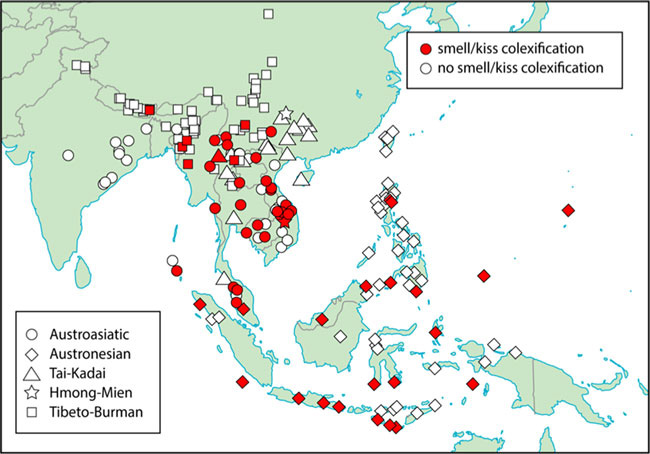
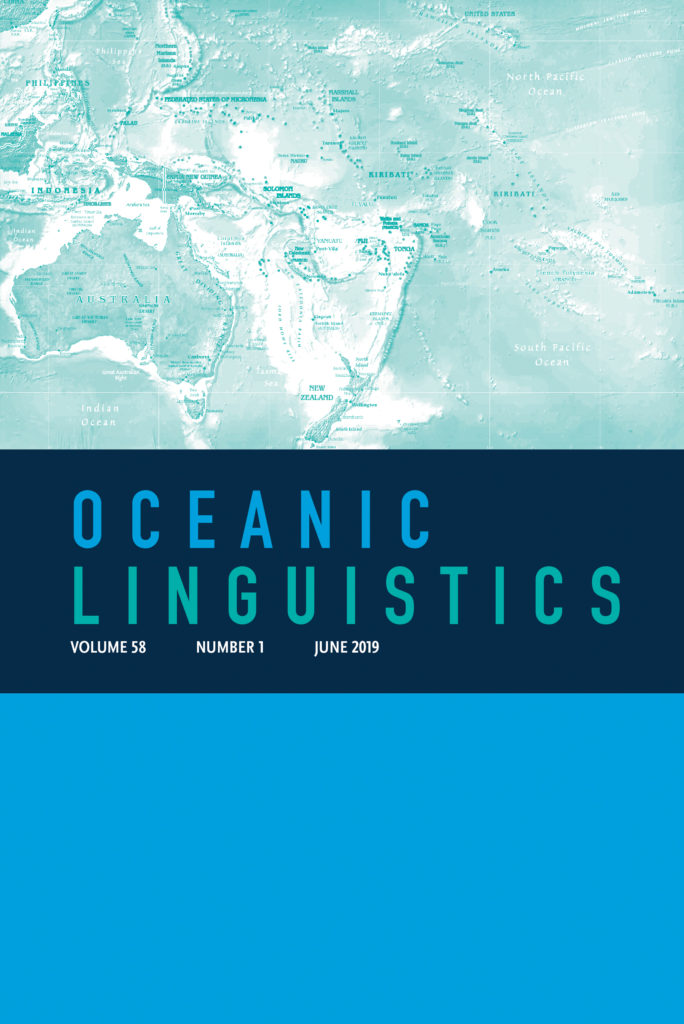
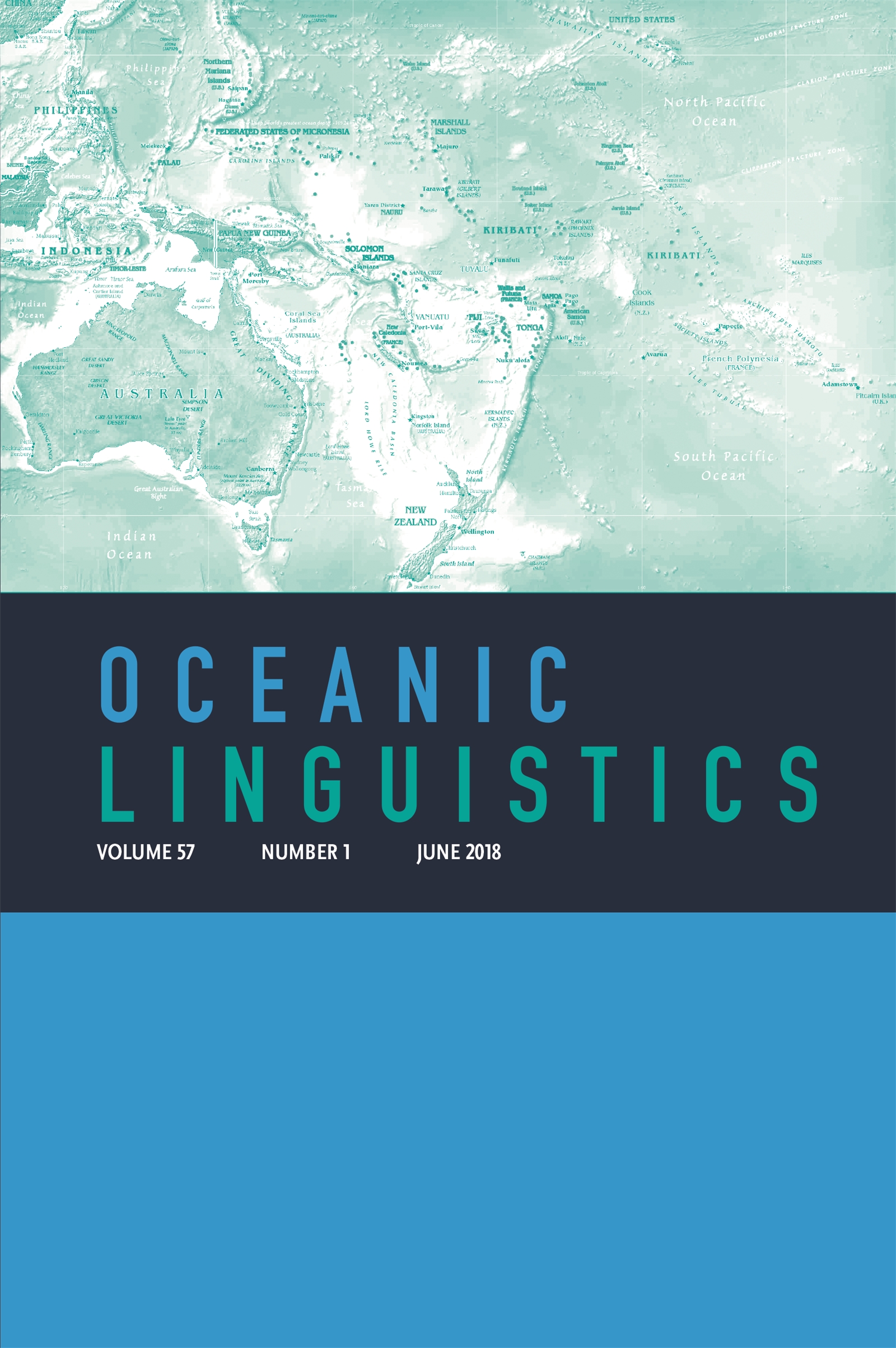
Map 1, Distribution of Smell/Kiss Colexification in Southeast Asia and Beyond in Antoinette Schapper’s article, “The Ethno-Linguistic Relationship between Smelling and Kissing: A Southeast Asian Case Study” in this issue of Oceanic Linguistics.
The summer issue of Oceanic Linguistics is the first from the new editorial team, lead by Daniel Kaufman, Yuko Otsuka, and Antoinette Schapper. Read more about the transition in this issue’s editorial note. The journal is now accepting submissions online at oceaniclinguistics.msubmit.net.
We are proud to publish an extensive list of Pacific, Asian, and Southeast Asian studies journals. This Asian / Pacific American Heritage Month, explore and enjoy the following free journal content online:
Today, the 6th International Conference on Language Documentation & Conservation (ICLDC), Connecting Communities, Languages & Technology kicked off at the University of Hawai‘i at Mānoa. The conference features keynote talks, talk story sessions, workshops, papers, and posters. Two of our linguistic journal editors, Language Documentation & Conservation editor Nick Thieberger and Oceanic Linguistics co-editor Daniel Kaufman, are featured in the program.
In 2018, new content from Language Documentation & Conservation, Oceanic Linguistics, and the Journal of the Southeast Asian Linguistics Society garnered nearly 11,000 downloads worldwide on both Project MUSE and the University of Hawai‘i’s open access digital repository, ScholarSpace. Find the most downloaded 2018 articles from these three journals below. Continue reading “Top Downloaded Articles 2018: Language and Linguistics”
The December issue of Oceanic Linguistics marks the end of an era. Retiring editor John Lynch, managing editor Byron Bender, and review editor Robert Blust will join the editorial advisory board as a new, international team takes over the helm.
In the final pages of this issue, Lynch writes, “On behalf of the outgoing team, I would like to thank authors for the constant flow of submissions, and for their generous acceptance of decisions that are not always in their favor; and I would like to wish the incoming team all the best for the future of Oceanic Linguistics.” Learn more about the new Oceanic Linguistics team here.
In this issue, Robert Blust remembers Richard Bernard McGinn Jr. (1939-2018), a “scholar who had a lifetime commitment to the Austronesian languages of insular Southeast Asia, a talented fieldworker, a lively and enthusiastic teacher, a skilled administrator and facilitator, a friend and colleague with an irrepressible sense of humor, and a committed social activist in his retirement years.” Continue reading “Oceanic Linguistics, vol. 57, no. 2 (2018)”
After decades of leadership, the current editorial team of Oceanic Linguistics will pass the baton on to a new group of editors.
The upcoming issue—Volume 57, Issue 2—will be the final issue for editor John Lynch, managing editor Byron Bender, and review editor Bob Blust. The incoming team is comprised of three co-editors: Daniel Kaufman, Yuko Otsuka, and Antoinette Schapper. Owen Edwards will join the team as assistant editor and Alexander D. Smith will take over as review editor.
In its 57 years, Oceanic Linguistics has been lead by only three editors. Founding editor George W. Grace served for 30 years before his University of Hawai‘i (UH) at Mānoa Linguistics Department colleague Byron Bender took over as editor in 1992. Bender was editor until John Lynch, based at the University of the South Pacific, became editor in 2007. Bob Blust, also at UH, began as review editor in 1999.
Daniel Kaufman joins the team from Queens College and the Endangered Language Alliance, Yuko Otsuka from Sophia University, Antoinette Schapper from CNRS, Owen Edwards from Leiden University, and Alexander D. Smith from the University of North Texas. Lynch, Bender, and Blust will continue on as editorial advisory board members.
It’s been wonderful to work with both the outgoing and incoming editorial teams at Oceanic Linguistics. We wish our outgoing editors well in retirement and welcome the new team to this longstanding and important title.
Present-day Languages of Pentecost Island, from “A Follow-up Analysis of Listener (Mis)comprehension across Language Varieties in Pentecost, Vanuatu” by Cindy Schneider and Charlotte Gooskens in this issue of Oceanic Linguistics. Image Source: Andrew Gray, 2016.
The summer issue of Oceanic Linguistics includes the following works:
ARTICLES
The Genetic Status of Lamalamic: Phonological and Morphological Evidence by Jean-Christophe Verstraete
Plural-Marking Strategies in Äiwoo by Åshild Næss
Directional Systems in Philippine Languages by Maria Kristina S. Gallego
Sex Differentiable Terms in Languages of Flores Island: A Comparative Review by Gregory Forth
Counting by Tens: Specific Counting in Southeast Solomonic Languages by Deborah Hill and Paul Unger
A Follow-up Analysis of Listener (Mis)comprehension across Language Varieties in Pentecost, Vanuatu by Cindy Schneider and Charlotte Gooskens
The Plural Word hire in Alorese: Contact-Induced Change from Neighboring Alor-Pantar Languages by Francesca R. Moro
Lexical Tone in Metnyo Ambel by Laura Arnold
The “Mystery Aspirates” in Philippine Languages by Robert Blust
In Memoriam
In Memoriam: Jean-Claude Rivierre, 1938–2018 by Claire Moyse-Faurie
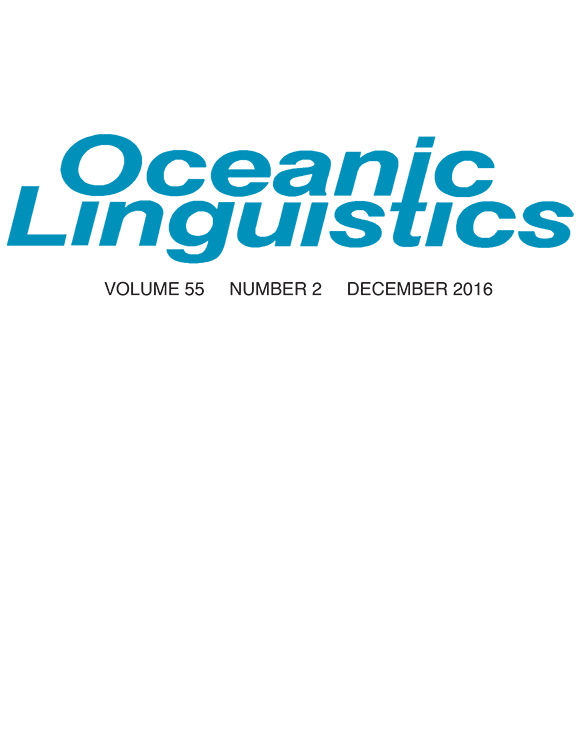
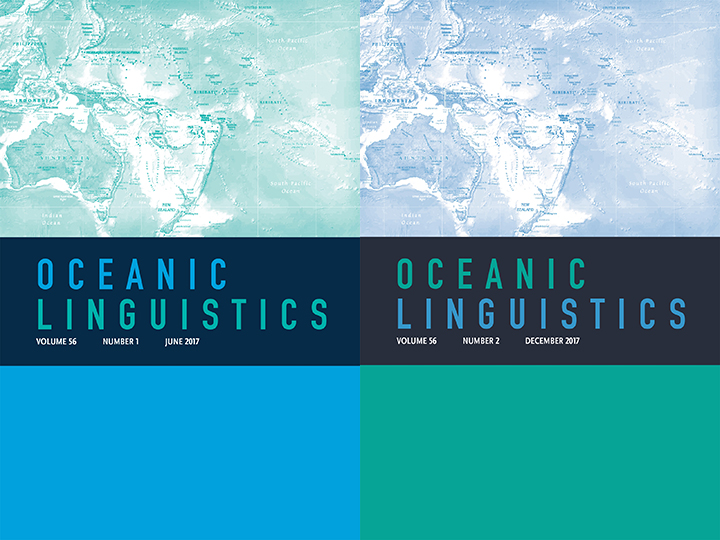
Earlier this year, we unveiled a new cover for Oceanic Linguistics in the first issue of volume 56. The second issue of each year has the same design with an alternate color scheme.
The new covers of Oceanic Linguistics.
In addition to the new look, the December issue includes the following works:
ARTICLES
Definiteness and Referentiality in Rapa Nui: The Interplay of Determiners and Demonstratives by Paulus Kieviet
Dynamism and Change in the Possessive Classifier System of Iaai by Anne-Laure Dotte
Toward Paradigm Uniformity: A Longitudinal Study in Alamblak by Les Bruce
Evidence of Contact between Binanderean and Oceanic Languages by Joel Bradshaw
Epenthetic and Contrastive Glottal Stops in Amarasi by Owen Edwards
The Western Malayo-Polynesian Problem by Alexander D. Smith
Squib
Regular Metathesis in Batanic (Northern Philippines)? by Robert Blust
This is Part 3 in a series of University of Hawai`i Press blog posts celebrating University Press Week and highlighting scholarship published by UH Press journals in the past year. Read our introductory blog post here.Our hope is that this series will shed new light on how UH Press “sells the facts,” so to speak, and the value our 24 journals bring to our very existence. Links to each journal and article are provided below.*
Context: Published twice a year, MĀNOA features contemporary literature from Asia and the Pacific, often in translation. Volume 28 includes the work of author Zhang Yihe, whose novellas were banned in China and appear here in English for the first time. Charged as a counter-revolutionary in China, Yihe based her stories on the people she met while sentenced to 21 years in a remote labor prison. In 2017, MĀNOA was awarded $10,000 grant to pursue new projects in Burma and Cambodia from the National Endowment of the Arts, which is currently under threat of discontinued federal funding.
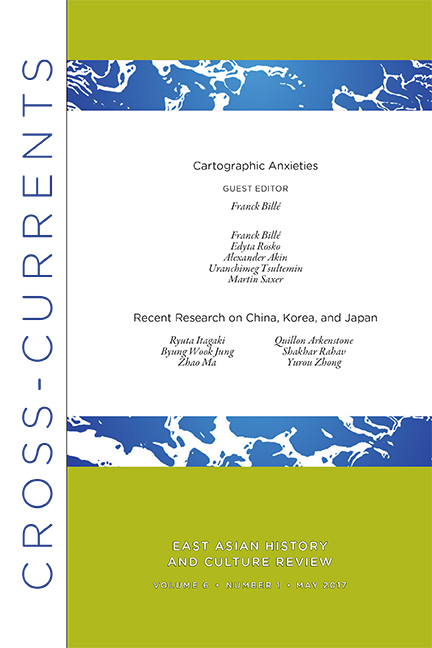
Context: Scholar Zhao Ma explores the process of a nation’s remembering and forgetting the bloodshed and fervor behind a war—in this case, China’s involvement with North Korea—when it is recast through state-run media and propaganda.
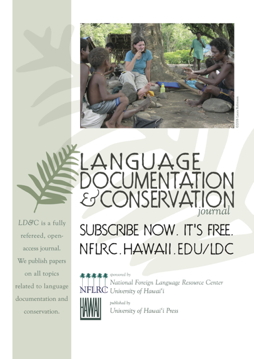
Context: As LD&C celebrates its 10th anniversary, editor Nick Thieberger takes a look at the journal’s downloads, Facebook following, and other statistics that have brought the open-access journal’s research to linguistics scholars across the globe, and wonders how new technology will change the field in the coming decade.
Context: This study on linguistics changes in Malaysia carries more weight than if it had been published in previous years. From the article’s introduction: “In our view, social network can be studied as a proxy of interlinked determinants of language maintenance or shift. Investigating the influence of social network on language choice would contribute to a holistic understanding of factors determining language shift.”
*Institutional access to online aggregators such as Project MUSE may be required for full-text reading. For access questions, please see the Project MUSE FAQ available here or contact your local library.
Established in 1947, the University of Hawai`i Press supports the mission of the university through the publication of books and journals of exceptional merit. The Press strives to advance knowledge through the dissemination of scholarship—new information, interpretations, methods of analysis—with a primary focus on Asian, Pacific, Hawaiian, Asian American, and global studies. It also serves the public interest by providing high-quality books, journals and resource materials of educational value on topics related to Hawai`i’s people, culture, and natural environment. Through its publications the Press seeks to stimulate public debate and educate both within and outside the classroom.
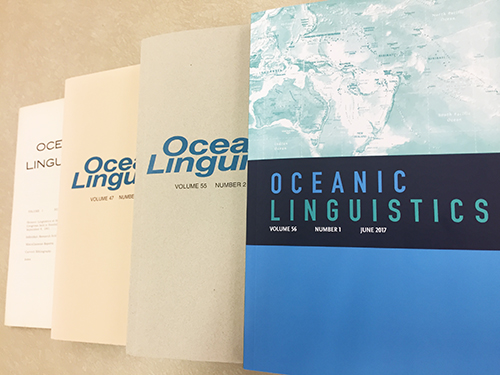
In 55 years, Oceanic Linguistics has grown from a 41-page inaugural issue stapled together to perfect-bound tomes published biannually. But as the field—and the journal—expanded, the cover remained constant with its signature blue logo since 1966. Now in its 56th volume, Oceanic Linguistics has a new look, reflecting Oceania.
Verb-Adjacent Clitic Climbing and Restructuring in Isbukun Bunun by Lillian Li-Ying Li
Influence of Social Network on Language Use of Kejaman Speakers
in Sarawak, Malaysia: by Amee Joan and Su-Hie Ting
The Vitality of Minority Languages in Malaysia by Paolo Coluzzi
Event Integration and Argument Realization in Nonconcordant Verb Serialization in Tsou by Gujing Lin
A First Reconstruction of Vowels in Proto-Timor-Alor-Pantar by Tyler M. Heston
Squibs
The Challenge of Semantic Reconstruction: Proto-Malayo-Polynesian *suku ‘lineage; quarter’? by Robert Blust
Stress and Gemination in Alor-Pantar Languages: Revising Heston (2016) by Antoinette Schapper
REVIEWS
Jean-Michel Charpentier and Alexandre François’s Linguistic atlas of French Polynesia/Atlas linguistique de la Polynésie françaisereviewed by Mary Walworth
In 56 years, Oceanic Linguistics has been led by only three editors: George W. Grace, Byron Bender, and John Lynch. Below, Lynch shares the journal’s history, how he managed to complete Vol. 54 in the middle of a hurricane, and how the journal has kept up with its expanding field.
John Lynch, editor of Oceanic Linguistics since 2007.
Oceanic Linguistics will publish its 56th volume this year. Tell us about the history of the journal.
OL was founded in 1962 on the recommendation of the Tenth Pacific Science Congress, held in Honolulu in 1961. The founding editor, George W. Grace, was then at Southern Illinois University; in 1964 he moved to the UH, and brought the journal with him. After 30 years as editor, he handed over to a colleague in the UH Linguistics Dept., Byron W. Bender, who continued as editor till 2007, when he handed over to me. (See Grace, Bender, and Lynch 2011. “The first fifty years of Oceanic Linguistics.” Oceanic Linguistics 50(2):285–311.)
Tell us about your journey to become editor of Oceanic Linguistics.
I had been an associate editor of OL since 1999, but that just consisted of refereeing the occasional paper. A cabal consisting of the two previous editors, two other UH faculty associated with the journal, and a linguist then at UH Press suggested to me that, since Byron Bender wanted to retire as editor, perhaps the editorship should move south of the equator — and I was their suggested nominee. I guess the fact that I am originally from Australia, have a UH PhD, have lived in Papua New Guinea and Vanuatu since 1970, and was about to retire was qualification enough.
George W. Grace (right) in Houaïlou, New Caledonia, in 1955. Source: Wikipedia. Grace founded the journal in 1962 and served as editor for 30 years. See Robert Blust’s “In Memoriam: George William Grace (1921-2015)” in Vol. 54, Issue 2.
In your field, what issues are particularly relevant now?
Two issues have remained relevant for many years. One is the historical interrelationships of the languages of the Pacific, both Austronesian and non-Austronesian, and the contribution of this study to wider Pacific prehistory. The other is the contribution that Pacific linguists can make to the general study of language and linguistic theory.
How has Oceanic Linguistics evolved over the years? Do you foresee any changes on the horizon?
The major evolution has been in terms of size: many of the early issue were 100 pages or smaller; the most recent issue, on the other hand, runs to almost 400 pages. The field has expanded enormously in the last half-century, and the pool of potential authors has expanded along with it.
Byron Bender served as the second editor of OL for 15 years, and now serves as managing editor. Source: UH Dept. of Linguistics.
Is there an issue that you’re particularly proud of?
I’m especially proud of vol. 54, no. 1, of June, 2015. Final copy goes from my laptop to UH Press for printing. However, as I was about to prepare the final files, Cyclone Pam struck Vanuatu — the most powerful hurricane in Vanuatu’s history. We were without water for a few days and without power for two weeks. My son purchased a tiny gasoline generator, which kept lights and refrigerator going … and allowed OL 54(1) to be produced to deadline!
Do you have any advice for those interested in submitting to Oceanic Linguistics? What are you looking for in future issues?
Two things: 1) Find a topic that is interesting to other people, not just to you. And 2) write simply and clearly.
About the Journal
Oceanic Linguistics is the only journal devoted exclusively to the study of the indigenous languages of the Oceanic area and parts of Southeast Asia.
Subscriptions
Annual subscription rates are US$120 for institutions and US $40 for individuals. Click here to subscribe.
Submissions
All submissions and editorial inquiries should be addressed to John Lynch, Editor, at [email protected].
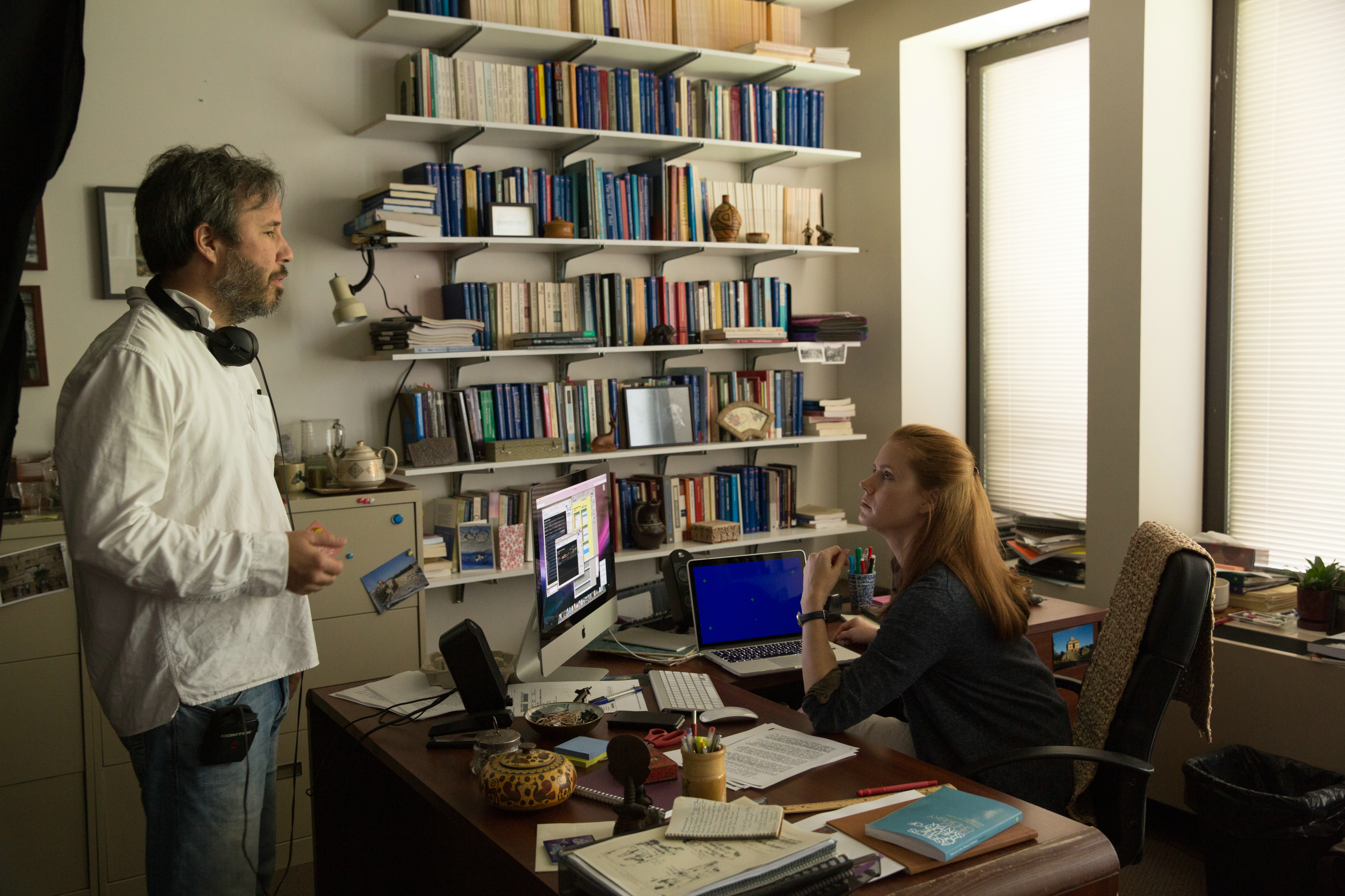
The 2016 science-fiction film Arrival features Dr. Louise Banks, who is called upon to communicate with aliens after they arrive on Earth. The linguistics professor, played by Amy Adams, is shown in this publicity still in her office full of linguistics books and journals, including Oceanic Linguistics!
According to “The making of a cinematic linguist’s office” on Language Log, the books in Dr. Banks’ office were borrowed from the film’s linguist consultants at McGill University, including Jessica Coon, Morgan Sonderegger, and Lisa deMena Travis (who published in Oceanic Linguistics Vol. 39 Issue 1).
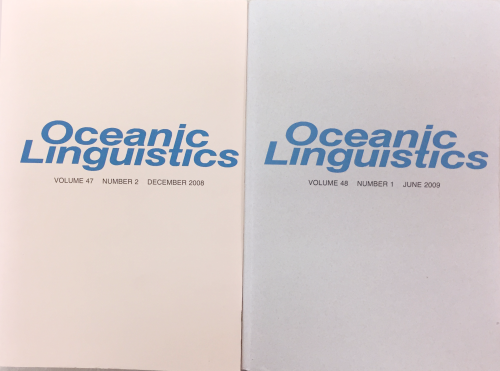
Though set designers were less interested in titles than blue and beige colored covers, it’s great to see Oceanic Linguistics on the big screen. The current cover design (left) was launched in the journal’s fifth volume in the Summer of 1966, with a cover stock update (right) in 2009.
This year, Oceanic Linguistics will unveil a new cover for this longstanding linguistics journal that continues to grow with its field. Stay tuned for the new cover and an interview with editor John Lynch.






 This is Part 3 in a series of University of Hawai`i Press blog posts celebrating University Press Week and highlighting scholarship published by UH Press journals in the past year.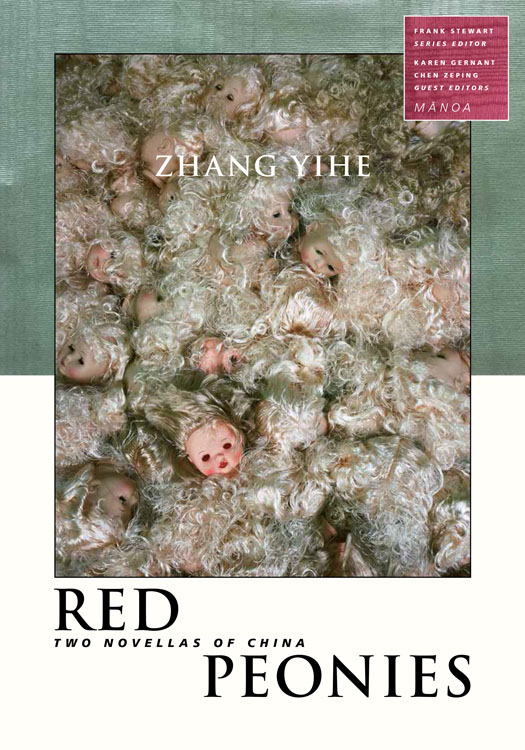

 Established in 1947, the University of Hawai`i Press supports the mission of the university through the publication of books and journals of exceptional merit. The Press strives to advance knowledge through the dissemination of scholarship—new information, interpretations, methods of analysis—with a primary focus on Asian, Pacific, Hawaiian, Asian American, and global studies. It also serves the public interest by providing high-quality books, journals and resource materials of educational value on topics related to Hawai`i’s people, culture, and natural environment. Through its publications the Press seeks to stimulate public debate and educate both within and outside the classroom.