This quarter’s journal of comparative Eastern and Western philosophies is a Special Issue entitled: Eleventh East-West Philosophers’ Conference, “State-of-the-Art on Comparative Philosophy” with guest editor Ron Bontekoe and includes the following scholarly works:
In Memoriam
Remembering Jiyuan Yu by Chenyang Li
special issue articles
Some Opening Remarks on the Exclusionary Tendency in Western Philosophy by Ron Bontekoe
The Place of Philosophy by Danielle Macbeth
Response to Danielle Macbeth, “The Place of Philosophy” by Stephen C. Angle
Reply to Stephen Angle by Danielle Macbeth
Ethnocentrism and Multiculturalism in Contemporary Philosophy by Brian Bruya
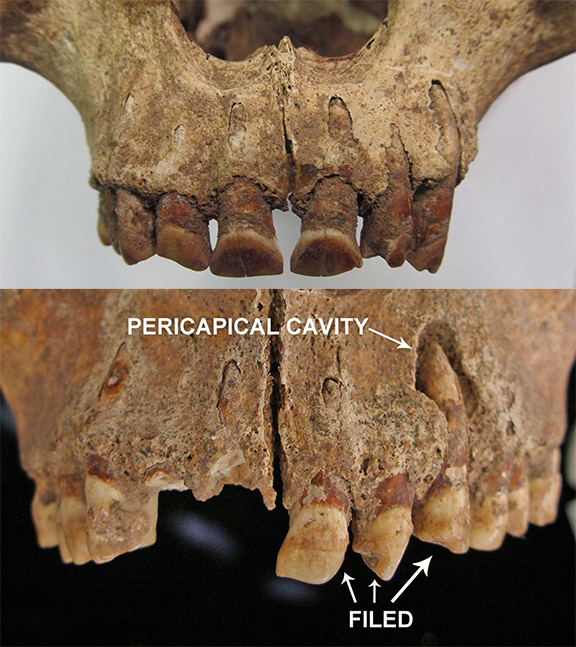
From “Biocultural Practices during the Transition to History at the Vat Komnou Cemetery, Angkor Borei, Cambodia” in this issue. Top image: Probable intentionally stained teeth of Vat Komnou Burial 43B, a 45–55+ year-old male. Photo by Rona Ikehara-Quebral. Bottom image: Filed maxillary permanent left incisors and canine of Vat Komnou Burial 36, a 35–45-year-old male. A periapical cavity surrounds the canine root. Photo by Rona Ikehara-Quebral.
Although Language Documentation & Conservation is a free online journal, subscribers are notified by email when a new issue is released. Subscribe to LD&C here.
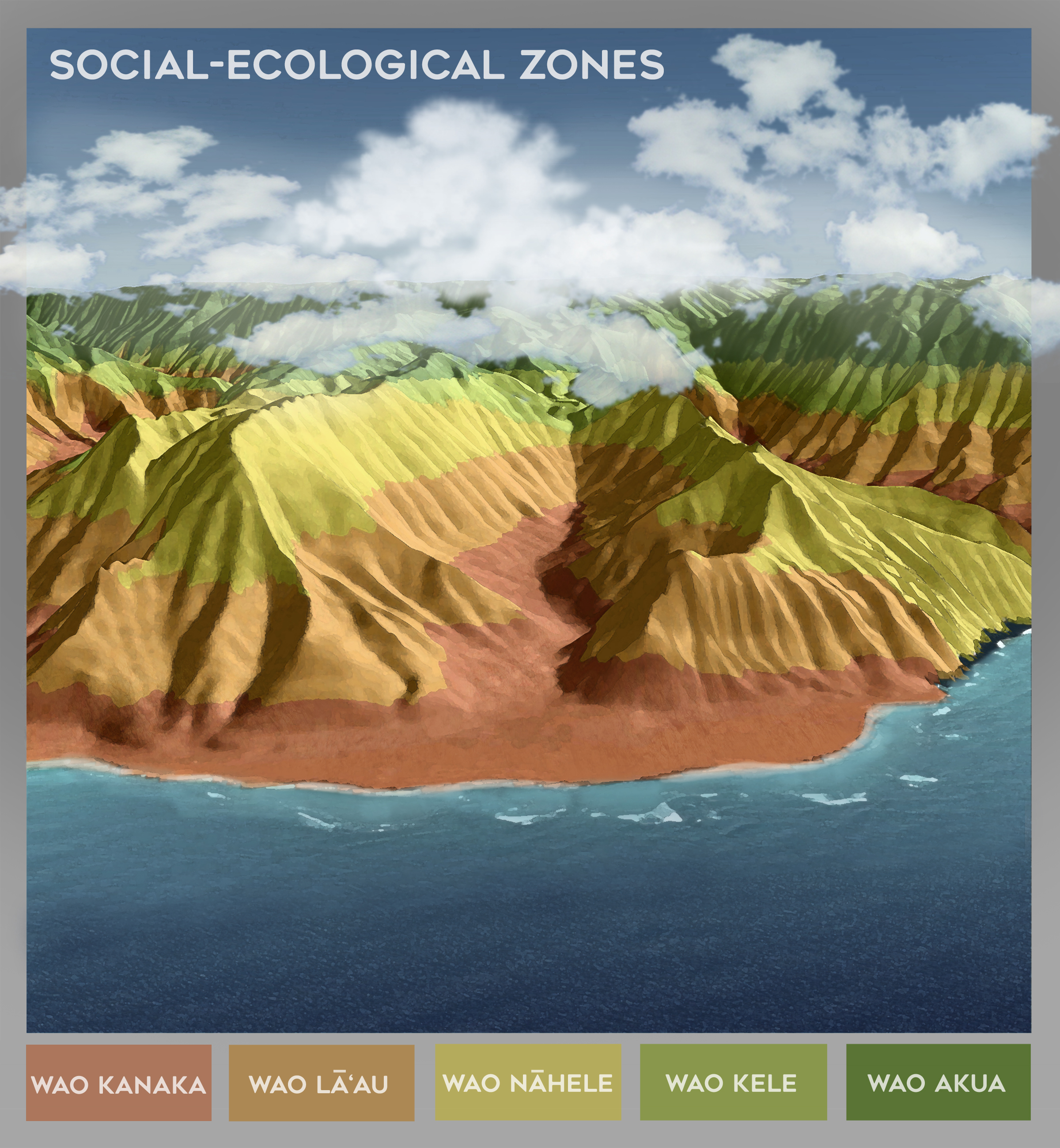
A visual interpretation for a spatial model of the social-ecological zones (wao kanaka, wao lā`au, wao nāhele, wao kele, wao akua) implemented during the aliʻi-era for the ahupuaʻa of Hāʻena, Haleleʻa, Kauaʻi. This model is being used by contemporary resource managers to inform large-scale biocultural conservation and forest restoration efforts within this social-ecological system (see Winter & Lucas, this issue for additional details; image credit: Ben Nyberg).
The October 2017 issue of Pacific Science begins with a Special Feature, which includes seven open-access articles available on Project MUSE and Bio-One.
Special Feature: Scaling Up Restoration Efforts in the Pacific Islands (Open-Access)
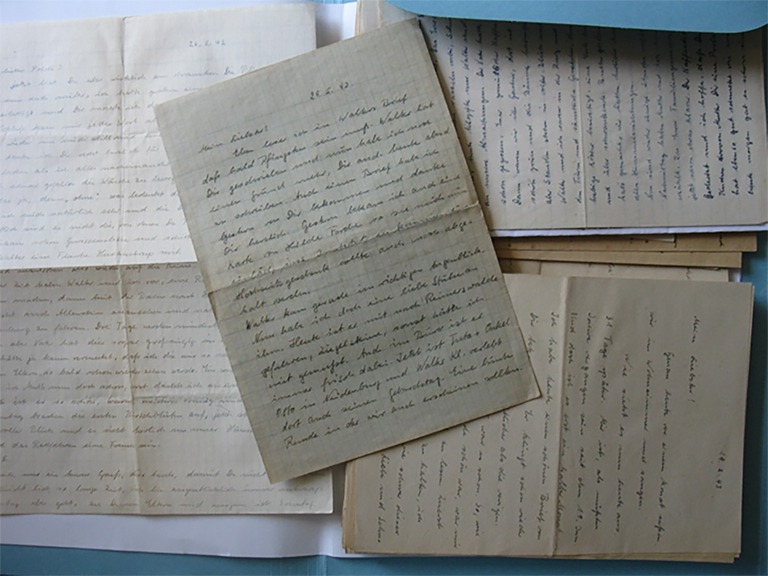
From Writing Through Crisis: Time, History, Futurity in German Diaries of the Second World War in this issue. Loose-leaf diary pages from the Deutsches Tagebucharchiv in Emmendingen. Photograph by Kathryn Sederberg.
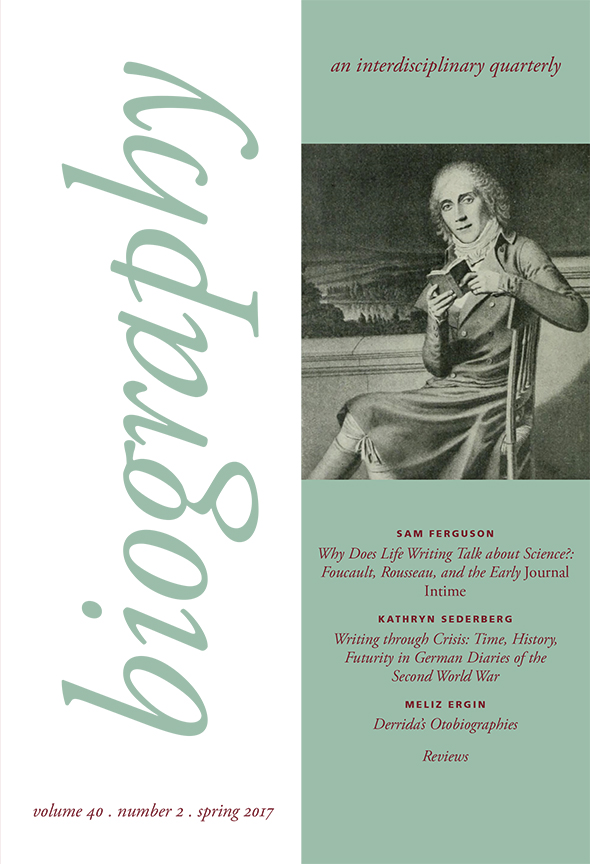
This quarter’s Biography opens with a tribute to Barbara Harlow, including this reflection on her life and work by UH Press author S. Shankar:
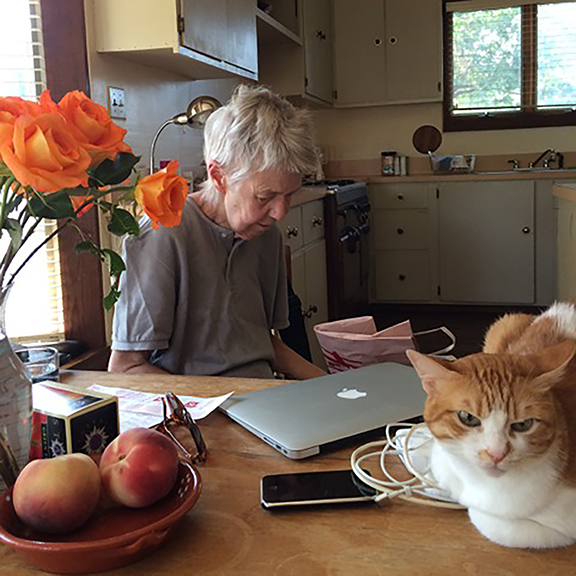
Photograph of Barbara Harlow in her home in Austin, Texas. Reprinted by permission of the photographer, Tarek El-Ariss.
Barbara Harlow was not a life writing scholar but she was a scholar of life writing. What I mean by this is that Barbara did not situate her work primarily in the field of life writing. Rather, she located it in Ethnic and Third World Studies—to invoke the name of the concentration she helped found in the Department of English at the University of Texas at Austin, where she taught for most of her career. At the same time, a regard for life writing genres is evident everywhere in her work—the book she was working on when she died was a biography of South African radical Ruth First; before that came the book After Lives: Legacies of Revolutionary Writing; and an entire chapter is devoted to life writing in Resistance Literature, her first published book. In that chapter, devoted to prison memoirs, she writes: “These memoirs are to be distinguished too from conventional autobiography inasmuch as the narratives are actively engaged in a re-definition of the self and the individual in terms of a collective enterprise and struggle” (120). So much of her critical work on life writing espouses the spirit of this statement.
For over thirty years, Biography: An Interdisciplinary Quarterly has explored the theoretical, generic, historical, and cultural dimensions of life-writing.
Subscriptions
Single issue sales and annual subscriptions for both individuals and institutions available here.
Submissions
Unsolicited manuscripts between 2,500 to 7,500 words are welcome. Email inquiries and editorial correspondence to [email protected].
University of Hawai’i Press is proud to present the early release of the following articles from Philosophy East and West: A Quarterly of Comparative Philosophy through a partnership with Project MUSE.
Please note: Early release manuscripts have gone through a rigorous peer-review process and will appear in a future issue of the journal. However, articles have not yet been through the full production process and therefore appear in their original manuscript form, which may contain errors. These articles will be removed from the early release page once they are published as part of an issue.
Stay tuned for more early release articles from UH Press journals in 2017.
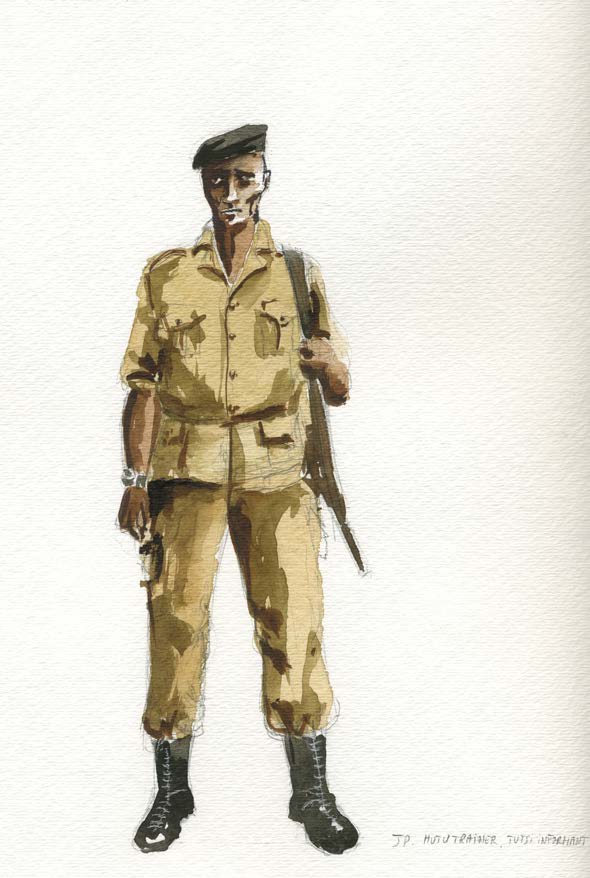
Accompanying artwork in Eyes of the Heart: The Selected Plays of Catherine Filloux from Camille Assaf, a French and American costume designer for theater, dance, opera, and film, and lead design editor at Chance, a photography magazine that looks at the world through the lens of theatrical design.
Playwright, librettist, teacher, lecturer, and activist Catherine Filloux has been writing plays about human rights, social justice, and individual freedoms for over twenty years. Her plays often incorporate actual people and events, but are never merely biographical. By reimagining real-life characters and situations—employing temporal shifts, dreams, hallucinations, soundscapes, and other theatrical techniques—she explores the characters’ thoughts and emotions as they struggle with moral and ethical dilemmas, resist evil while searching for goodness, and react to assaults on human dignity. Her plays also question the fallibility of our collective memory, and the ways our interpretations of the past change and become distorted over time.
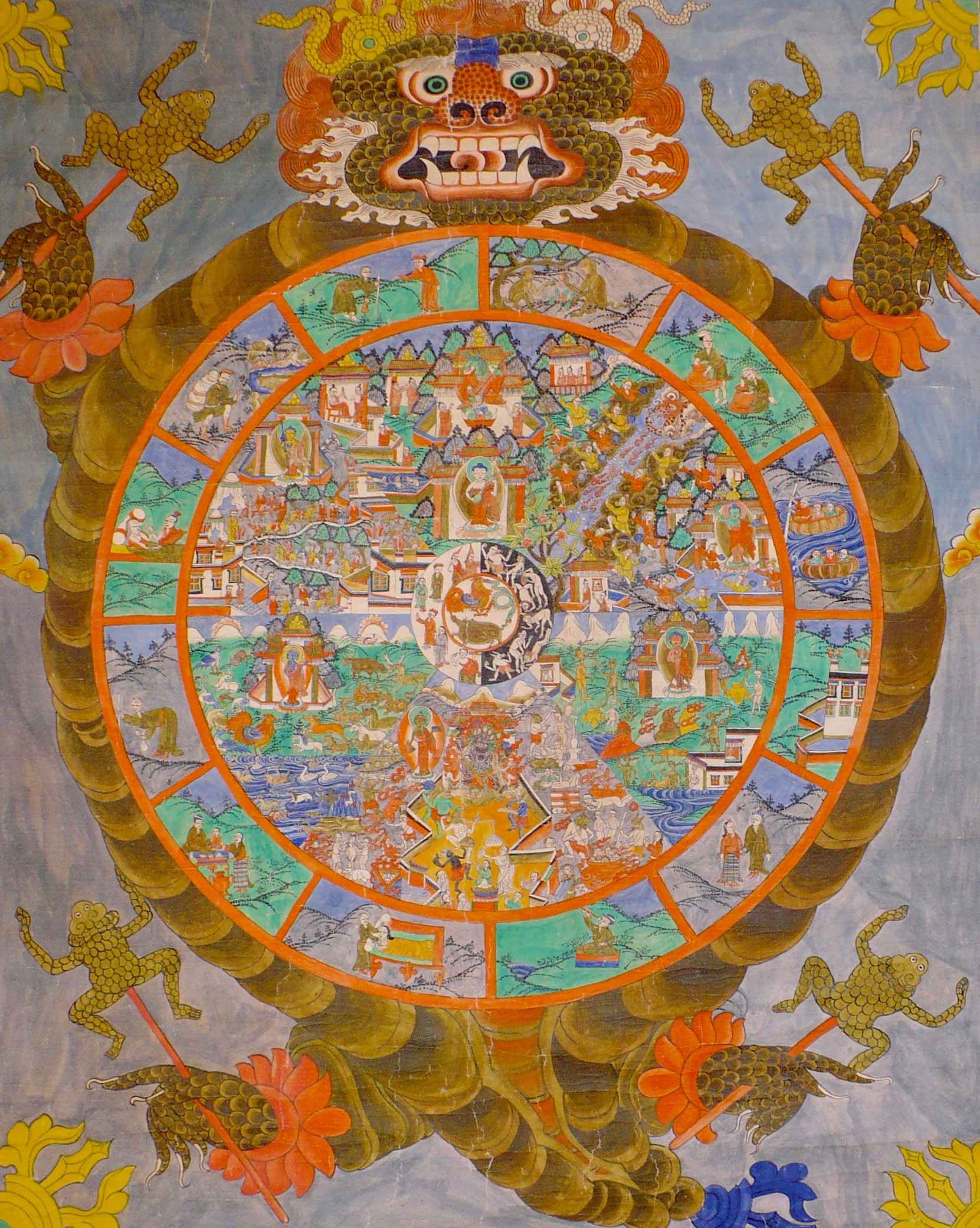
From Cartographic Anxieties in Mongolia: The Bogd Khan’s Picture-Map Uranchimeg Tsultemin. Bhavacakra, the Buddhist Wheel of Life. Thangka painting, Central Tibet, late nineteenth century. Source: Theos Bernard-Eleanor Murray collection, Berkeley Art Museum and Pacific Film Archive.
From Cartographic Anxieties in Mongolia: The Bogd Khan’s Picture-Map Uranchimeg Tsultemin. Bhavacakra, the Buddhist Wheel of Life. Thangka painting, Central Tibet, late nineteenth century. Source: Theos Bernard-Eleanor Murray collection, Berkeley Art Museum and Pacific Film Archive.
Special Issue: The 1,400th Anniversary of Wŏnhyo’s Birth
Robert E. Buswell Jr. and Eun-su Cho, Guest Editors
The year 2017 marks the 1,400th anniversary of the birth of Wŏnhyo 元曉 (‘‘Break of Dawn’’; 617–686), a towering figure in the Korean religious and intellectual firmament. Wŏnhyo was an important vaunt courier in the development of Korean Buddhism and it is no exaggeration to say that it was he who created the Silla tradition of the religion. Indeed, few others have exerted the depth and breadth of influence over the subsequent development of Korean Buddhism as did Wŏnhyo. His oeuvre is among the largest in the entire Korean intellectual tradition, comprising some one hundred works, of which over twenty are extant.
Special issue articles include:
Human Nature and Buddha Nature in Wŏnhyo by Jong Wook Kim
Towards a Buddhist Ethics of Emptiness: Wŏnhyo on Transgression and Repentance in the Mahayana Repentance of the Six Senses
by Eun-su Cho
Wŏnhyo’s View of This World
by Seunghak Koh
The Meaning of the Explicit and Inexplicit Approaches in Wŏnhyo’s System of the Two Hindrances
by Charles Muller
Kingship as ‘‘Dharma-Protector’’: A Comparative Study of Wŏnhyo’s and Huizhao’s Views on the Golden Light Sutra
by Sumi Lee
Wŏnhyo: Buddhist Commentator Par Excellence
by Robert E. Buswell Jr.
University of Hawai‘i Press is proud to present the early release of the following articles from Philosophy East and West: A Quarterly of Comparative Philosophy through a partnership with Project MUSE.
Please note: Early release manuscripts have gone through a rigorous peer-review process and will appear in a future issue of the journal. However, articles have not yet been through the full production process and therefore appear in their original manuscript form, which may contain errors. These articles will be removed from the early release page once they are published as part of an issue.
Stay tuned for more early release articles from UH Press journals in 2017.