




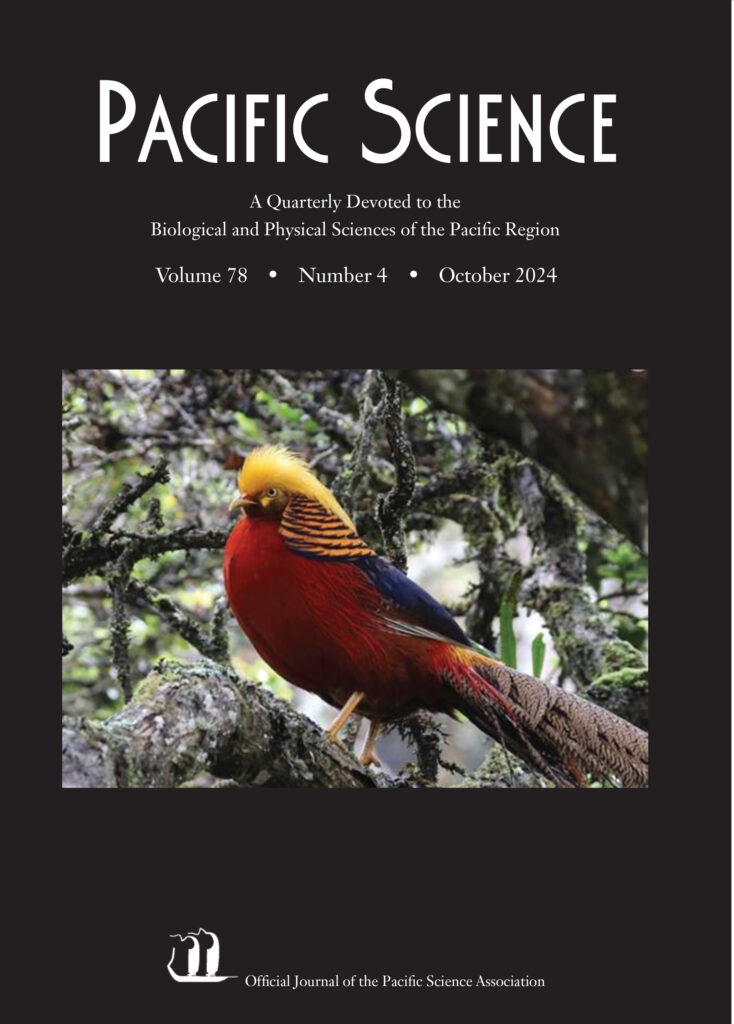
This issue features a striking black cover, a deliberate design choice inspired by an article on the dark-throated pheasant and its symbolic contrast with the pale-throated species.
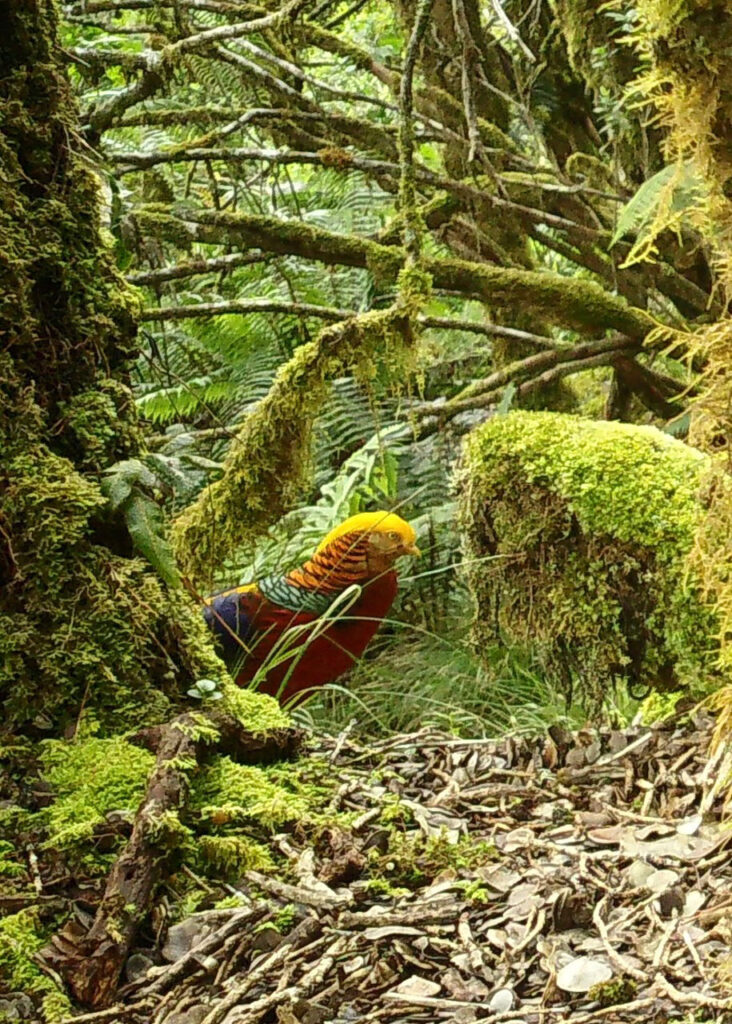
Ten More Years of the Golden Pheasant (Chrysolophus pictus) on Maui, Hawaiian Islands
Researchers Thane Pratt, Christopher C. Warren, Erika K. Kekiwi, Kerri Fay, and Richard J. Camp explore the fascinating contrasts between the dark-throated and pale-throated Golden Pheasant on Maui. The article discusses the history of these game birds as outlined in the abstract:
Since the introduction of the Golden Pheasant (Chrysolophus pictus) to
Haleakalā volcano, Maui, three decades ago, subsequent reports have hinted at an expansion of this nascent population. We draw from a variety of data sources to learn about this pheasant’s present status on Maui. First, forest bird surveys conducted every five years revealed that the frequency of Golden Pheasant detections has greatly increased, and the bird has both maintained its former distribution and expanded eastward into Haleakalā National Park (NP). Second, reports to eBird from The Nature Conservancy’s Waikamoi Preserve, where Golden Pheasants first appeared on Maui, demonstrate that the frequency of observations has increased and is strongly seasonal, predominantly in the spring. Third, autonomous recording units monitoring endangered forest birds recorded pheasants too, adding new locations. Finally, trail cameras set to monitor mammals picked up pheasants as well, showing males of two color morphs: original “wild-type” and “dark-throated.” Trail cameras also documented a small juvenile at Waikamoi Preserve and both females and males in Haleakalā NP. By “connecting the dots” of mapped occurrences, we traced the pheasant’s progression through a narrow band of subalpine cloud forest with open understory, extending from Waikamoi Preserve eastward to upper Kīpahulu Valley, a distance of 14 km. In summary, this body of evidence supports the claim that the Golden Pheasant has established a self-sustaining population on Maui, and we propose that the species’ success there may be attributed to the minimal influence of predators and the absence of competing gallinaceous birds in its preferred habitat.
Discover the issue here:
Pacific Science 78-4
Other articles in this issue:
Thor Heyerdahl’s Legacy: Ichthyological and Herpetological Collection on Fatu Hiva (Marquesas Islands) in 1937
Erwan Delrieu-Trottin, Thore Koppetsch, Ann-Helén Rønning, and
Michael Matschiner
Interactions between Humans and South American Sea Lions (Otaria byronia) during an Avian Flu Outbreak in the Southeastern Pacific
Liliana Ayala, Raúl Sánchez-Scaglioni, and Gonzalo Gómez
Length-Weight Relationships for 15 Coral Reef Fish Species from the Northern Line Islands
Anela K. Akiona, Brian J. Zgliczynski, Beverly J. French, and Stuart A. Sandin
Tracing the History of Māori Horticulture and Dogs (Canis familiaris) at Two Volcanic Cone Maunga Pā, Auckland, New Zealand, Using Microfossil and 14C Analyses
M. Horrocks, S. H. Bickler, A. Apfel, R. Shakles, E. Cameron, R. Foster, and B. Presswell
Weed Population Dynamics and Composition in a Tropical Island Eggplant (Solanum melongena L.) Agroecosystem: Implications for Sustainable Weed Management
Aradhana Devi Deesh, Leslie Toralba Ubaub, Michael Furlong, and Mereia Fong Lomavatu