



Celebrating the Golden Pheasant on Maui in the latest issue of Pacific Science 

This issue features a striking black cover, a deliberate design choice inspired by an article on the dark-throated pheasant and its symbolic contrast with the pale-throated species.
Golden Pheasant of Maui Pacific Scinece 78-4
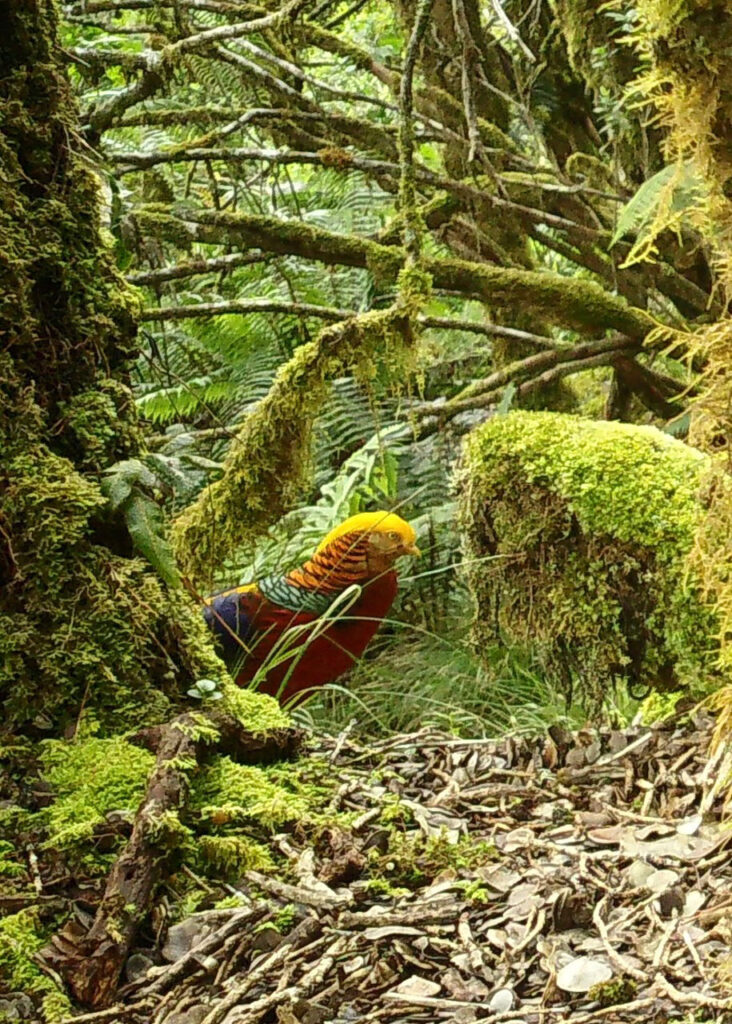
Photo: Golden Pheasant (Chryslophus pictus) male of the “pale-throated” morph.  Compare with the “dark-throated” morph on the front cover.  Photographed by Chris Daniels at upper Kīpahulu Valley, Haleakalā National Park, 30 August 2021. 

Ten More Years of the Golden Pheasant (Chrysolophus pictus) on Maui, Hawaiian Islands

Researchers Thane Pratt, Christopher C. Warren, Erika K. Kekiwi, Kerri Fay, and Richard J. Camp explore the fascinating contrasts between the dark-throated and pale-throated Golden Pheasant on Maui. The article discusses the history of these game birds as outlined in the abstract:

Since the introduction of the Golden Pheasant (Chrysolophus pictus) to
Haleakalā volcano, Maui, three decades ago, subsequent reports have hinted at an expansion of this nascent population. We draw from a variety of data sources to learn about this pheasant’s present status on Maui. First, forest bird surveys conducted every five years revealed that the frequency of Golden Pheasant detections has greatly increased, and the bird has both maintained its former distribution and expanded eastward into Haleakalā National Park (NP). Second, reports to eBird from The Nature Conservancy’s Waikamoi Preserve, where Golden Pheasants first appeared on Maui, demonstrate that the frequency of observations has increased and is strongly seasonal, predominantly in the spring. Third, autonomous recording units monitoring endangered forest birds recorded pheasants too, adding new locations. Finally, trail cameras set to monitor mammals picked up pheasants as well, showing males of two color morphs: original “wild-type” and “dark-throated.” Trail cameras also documented a small juvenile at Waikamoi Preserve and both females and males in Haleakalā NP. By “connecting the dots” of mapped occurrences, we traced the pheasant’s progression through a narrow band of subalpine cloud forest with open understory, extending from Waikamoi Preserve eastward to upper Kīpahulu Valley, a distance of 14 km. In summary, this body of evidence supports the claim that the Golden Pheasant has established a self-sustaining population on Maui, and we propose that the species’ success there may be attributed to the minimal influence of predators and the absence of competing gallinaceous birds in its preferred habitat.

Discover the issue here:

Pacific Science 78-4
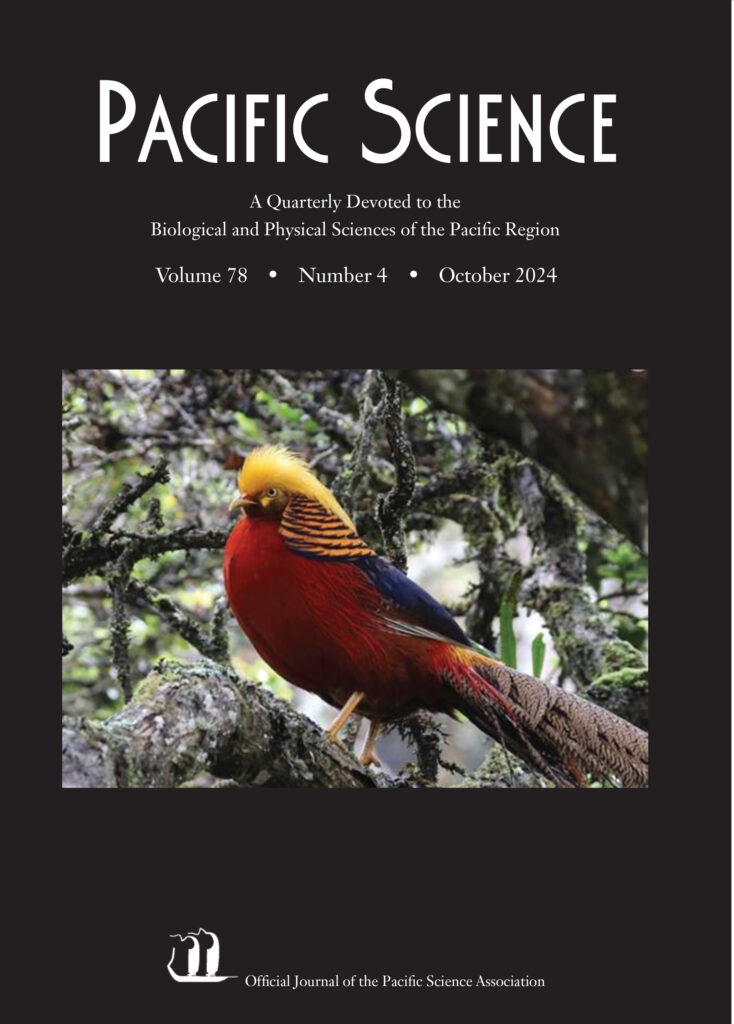
Pacific Science 78-4 cover

Other articles in this issue:

Thor Heyerdahl’s Legacy: Ichthyological and Herpetological Collection on Fatu Hiva (Marquesas Islands) in 1937
Erwan Delrieu-Trottin, Thore Koppetsch, Ann-Helén Rønning, and
Michael Matschiner

Interactions between Humans and South American Sea Lions (Otaria byronia) during an Avian Flu Outbreak in the Southeastern Pacific
Liliana Ayala, Raúl Sánchez-Scaglioni, and Gonzalo Gómez


Length-Weight Relationships for 15 Coral Reef Fish Species from the Northern Line Islands
Anela K. Akiona, Brian J. Zgliczynski, Beverly J. French, and Stuart A. Sandin


Tracing the History of Māori Horticulture and Dogs (Canis familiaris) at Two Volcanic Cone Maunga Pā, Auckland, New Zealand, Using Microfossil and 14C Analyses
M. Horrocks, S. H. Bickler, A. Apfel, R. Shakles, E. Cameron, R. Foster, and B. Presswell

Weed Population Dynamics and Composition in a Tropical Island Eggplant (Solanum melongena L.) Agroecosystem: Implications for Sustainable Weed Management
Aradhana Devi Deesh, Leslie Toralba Ubaub, Michael Furlong, and Mereia Fong Lomavatu
Pacific Science, vol. 72, no. 2 (April 2018)

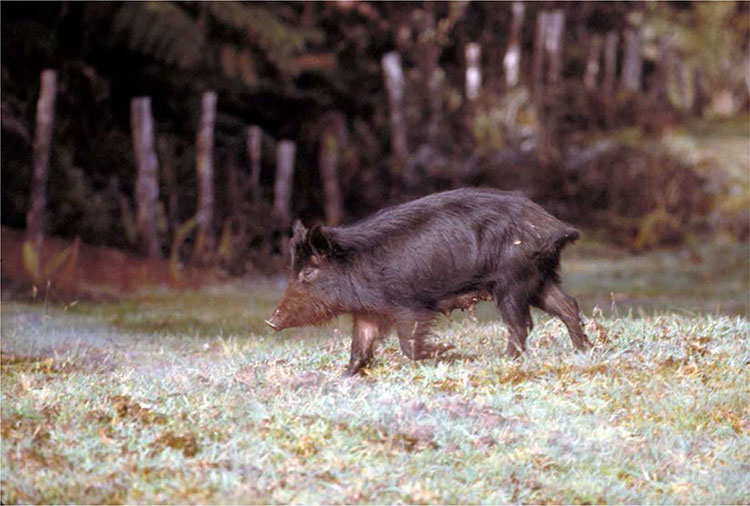
Picture of a feral pig on Hawai'i Island
Lactating feral pig, Sus scrofa, on Hawai‘i Island from “Biology and Impacts of Pacific Islands Invasive Species. 14. Sus scrofa, the Feral Pig (Artiodactyla: Suidae)” in this issue. (Photo: U.S. Geological Survey.)

The second issue in volume 72 of Pacific Science, the official journal of the Pacific Science Association, includes the 14th article in the “Biology and Impacts of Pacific Islands Invasive Species” series, plus seven more research articles.

Preview volume 72, number 2 below and find a list of all articles available on BioOne and Project MUSE.

Contents

…plus Association Affairs from the PSA.


Find the full text of the issue at BioOne


Browse the TOC and read full text online at Project MUSE


Cover of Pacific Science volume 72, number 2 (April 2018)
Pacific Science volume 72, number 2 (April 2018)

About the Journal

Appearing quarterly since 1947, Pacific Science is an international, multidisciplinary journal reporting research on the biological and physical sciences of the Pacific basin. It focuses on biogeography, ecology, evolution, geology and volcanology, oceanography, paleontology, and systematics.

Subscriptions

Individual subscription is by membership in the Pacific Science Association. Institutional subscriptions available through UH Press.

Submissions

Contributions to the biological and physical sciences of the Pacific area are welcomed from authors in all parts of the world. See Pacific Science‘s submission guidelines for details.

Pacific Science, vol. 72, no. 1 (January 2018)

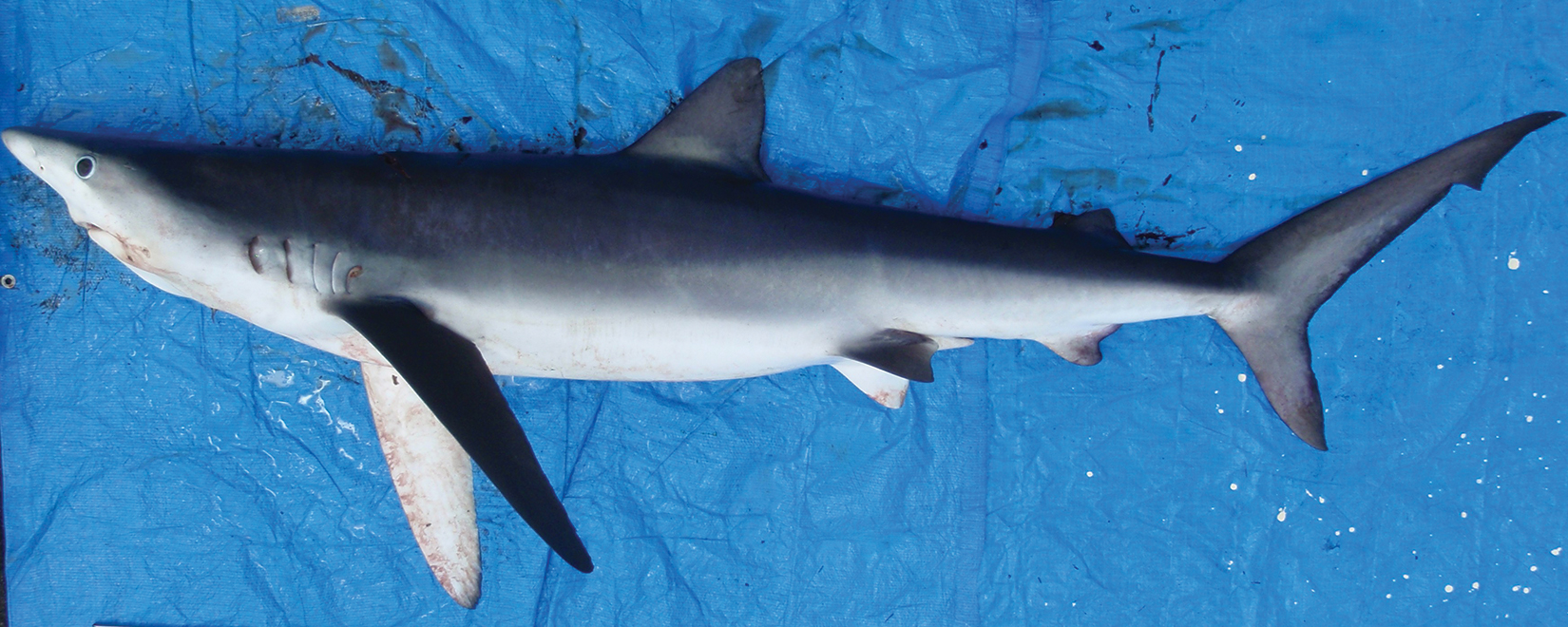
A blue shark
A blue shark (Prionace glauca) caught by a Japanese research vessel in the western North Pacific Ocean. Fujinami et al. (this issue) analyzed feeding habits of blue sharks in the Northwestern Pacific. Photo credit: Akira Kurashima, National Research Institute of Far Seas Fisheries.

Pacific Science, the official journal of the Pacific Science Association, begins 2018 with new research on sharks, dolphins, cats, and more biological and physical studies. Preview volume 72, number 1 below and find a list of all articles available on Bio-One and Project MUSE.

Contents

  • Loss of Reservoir Capacity through Sedimentation in Hawai‘i: Management Implications for the Twenty-First Century by Kim Falinski and David Pen

  • Feeding Habits of the Blue Shark (Prionace glauca) in the Northwestern Pacific Based on Stomach Contents and Stable Isotope Ratios by Yuki Fujinami, Sayaka Nakatsuka, and Seiji Ohshimo

  • Presence, Behavior, and Resighting Pattern of Transient Bottlenose Dolphins (Tursiops truncatus) in the Humboldt Current System off North-Central Chile by Macarena Santos-Carvallo, Maritza Sepúlveda, Rodrigo Moraga, Mauricio F. Landaeta, Doris Oliva, and María José Pérez-Alvarez

  • Modeling Impacts of Hunting on Control of an Insular Feral Cat Population by Brian T. Leo, James J. Anderson, James Ha, Reese B. Phillips, and Renee R. Ha

  • Resource Availability, Propagule Supply, and Effect of Nonnative Ungulate Herbivores on Senecio madagascariensis Invasion by Erin J. Questad, Amanda Uowolo, Sam Brooks, Robert Fitch, and Susan Cordell

…plus more articles and Association Affairs from the PSA.


Find the full text of the issue at Project MUSE


Pacific Science 72:1
Pacific Science vol. 72, no. 1 (January 2018)

About the Journal

Appearing quarterly since 1947, Pacific Science is an international, multidisciplinary journal reporting research on the biological and physical sciences of the Pacific basin. It focuses on biogeography, ecology, evolution, geology and volcanology, oceanography, paleontology, and systematics.

Subscriptions

Individual subscription is by membership in the Pacific Science Association. Institutional subscriptions available through UH Press.

Submissions

Contributions to the biological and physical sciences of the Pacific area are welcomed from authors in all parts of the world. See Pacific Science‘s submission guidelines for details.

Pacific Science Call for Papers

By U.S. Fish & Wildlife Service – Pacific Region
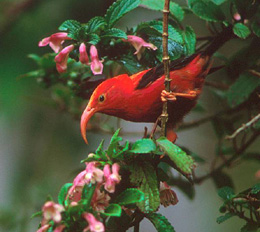
‘I’iwi on native mint in the Hakalau Forest National Wildlife Refuge.

Special Issue: Scaling up Restoration Efforts in the Pacific Regions

Pacific Science , a journal dedicated to biological and physical sciences, is calling for submissions to a special issue focusing on identifying challenges and solutions in the process of scaling up restoration efforts in the Pacific Islands. Continue reading “Pacific Science Call for Papers”