




Chinese Studies International
Volume 29 (2025)
Contract Law in Hong Kong (Fourth Edition) by Michael J. Fisher and Desmond G. Greenwood (review)
Tristan G. Brown
Women and Their Warlords: Domesticating Militarism in Modern China by Kate Merkel-Hess (review)
Peter J. Carroll
The Making of China’s Post Office: Sovereignty, Modernization and the Connection of a Nation by Weiping Tsai (review)
Michael G. Chang
Fear of Seeing: A Poetics of Chinese Science Fiction by Mingwei Song (review)
Virginia L. Conn
Sketching Hong Kong: The Drawings of Eddie Chau ed. by Phoebe Wong (review)
Madeline Eschenburg
Sons of Chinatown: A Memoir Rooted in China and America by William Gee Wong (review)
Meredith Oyen
Find these reviews and more at Project MUSE.
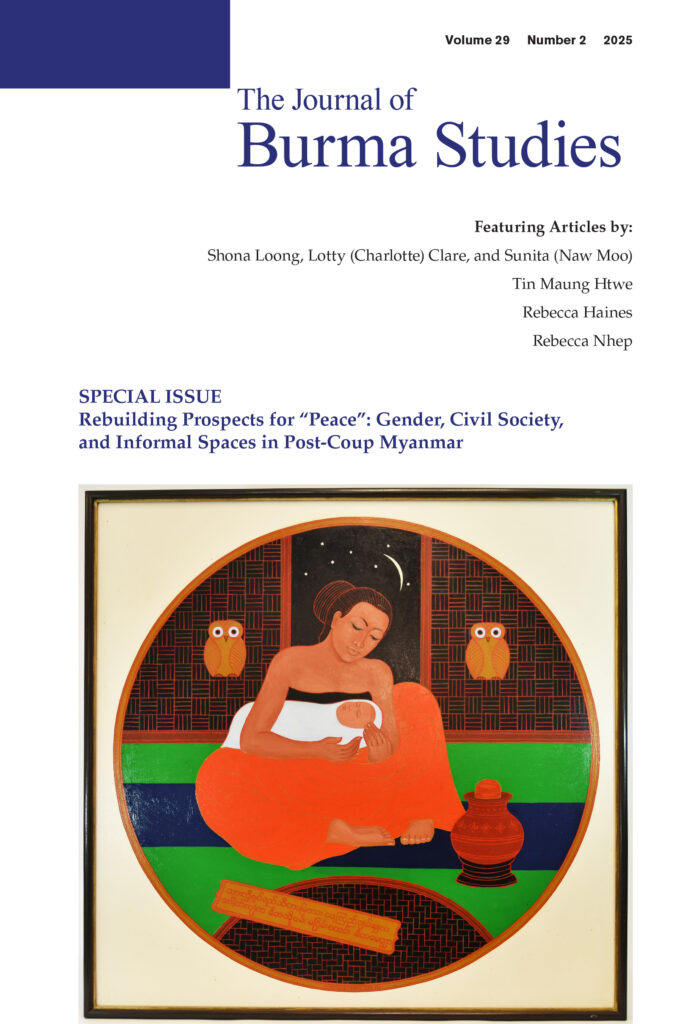
The Journal of Burma Studies
Volume 29, Number 2 (2025)
Special Issue: Rebuilding Prospects for “Peace”: Gender, Civil Society, and Informal Spaces in Post-Coup Myanmar
Special Guest Editors Julia Palmiano Federer and Aye Myat Su Wai, along with authors Laura O’Connor and Mariana Savka, discuss this special issue in the introduction stating:
This Special Issue explores the intricate themes of gender, civil society, and informal peace spaces in postcoup Myanmar. This collection of articles situates Myanmar women’s initiatives, practices, and spaces within Myanmar’s historical, political, and cultural context rather than broader attempts to promote women’s inclusion in ongoing peace processes as per the Women, Peace, and Security Agenda (Olivius, Hedström, and Zin Mar Phyo 2022). We view that in the ashes of a failed national-level Nationwide Ceasefire Agreement (NCA) process (2011–2015) and the fraught efforts to manage the fractured talks between different fronts of armed resistance (2016–2021) (Thawnghmung and Htoo 2022), a gendered analysis of women’s informal and unofficial peacebuilding efforts sheds light on the unique ways in which Myanmar women are mitigating conflict and sustaining “peace” after the 2021 military coup. In the context of a revolutionary conflict, the meaning of “peace” is constantly renegotiated and redefined with a focus onpower relations between antagonistic political actors. We choose to understand “peace” and, by extension, “peacebuilding” as moving beyond the stabilization of conflict toward a set of pragmatist visions of liberal peace in times of conflict (Bargués 2024).
Read this introduction, articles, and more at Project MUSE.
Journal of World History
Volume 36, Number 3 (2025)
Lifesaving, Sovereignty, and the Place of the Late Ottoman Empire in the European International Order
Lukas Schemper
Turkish Anticolonialism and Muslim Southeast Asia, 1923–1949: Vernacular Diplomacy “Under the Yoke of 3 and a Half Dutchmen”
Moritz Koenig and Didem Kizir
Making Perfect Markets: The Demand for Global Numbers at the Origin of the International Institute of Agriculture
Federico D’Onofrio and Niccolò Mignemi
Wealth, Health, and the Transnational Pesticide System: Tense Entanglements between the USA and Germany at the End of the Nineteenth Century
Benjamin Brendel
Traversing Multiple Sites of Transit: Repatriating “Mentally Distressed” British Seamen, 1925–30
Jennifer S. Kain
Find these research articles, book reviews, and more at Project MUSE.
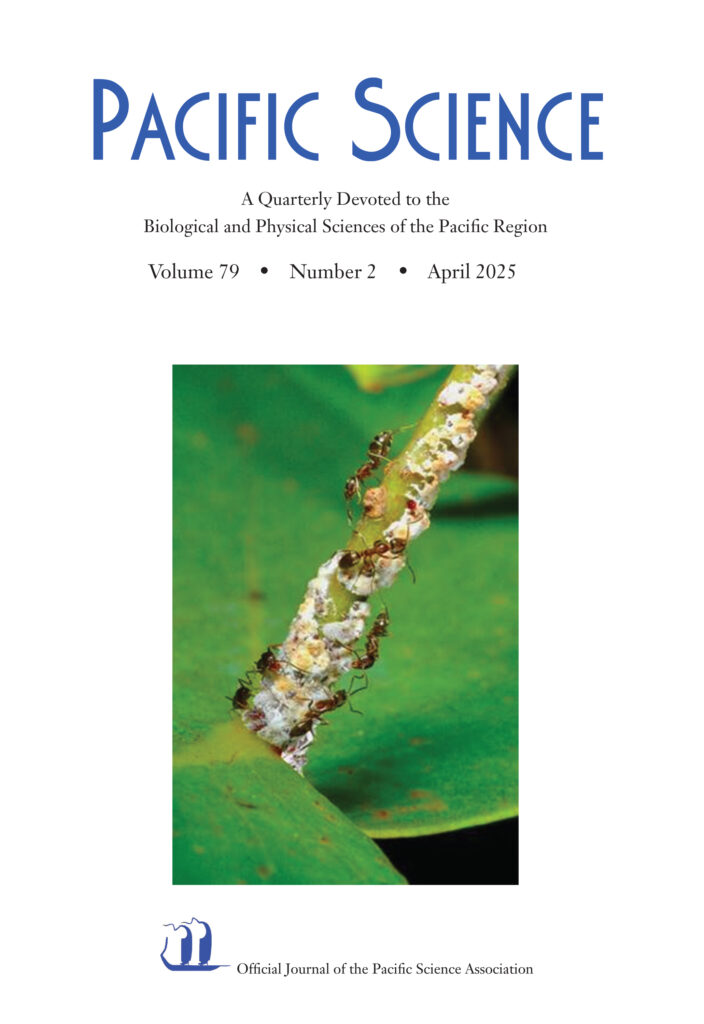
Pacific Science
Volume 79, Number 2 (2025)
Biology and Impacts of Pacific Island Invasive Species. 18. Linepithema humile, the Argentine Ant (Formicidae)
Antoine Felden
Reexamination of Rat Lungworm (Angiostrongylus cantonensis: Nematoda) Prevalence in Wild Rattus spp. on the Island of Kaua’i after a 60-Year Hiatus
Israel L. Leinbach, Chris N. Niebuhr, Jaime A. Botet-Rodriguez, Carmen C. Antaky, and Steven C. Hess
Taxonomic and Geographic Distributions of Native Angiosperms in the Islands of French Polynesia (South Pacific): An Analysis Based on the Nadeaud Botanical Database
Léa Gros, Jean-Yves Meyer, Robin Pouteau, and Philippe Marmey
Evaluating the Effect of Invasive Rat Management on Habitat Regeneration for Kaua’i’s Forest Birds
Ashley Cozette Romero, Lyssa Lini, and Liba Pejchar
Uncovering the Genetic Diversity of Adenophorus tripinnatifidus Gaudich. (Polypodiaceae), a Hawaiian Islands Endemic Fern
Nipuni Sirimalwatta, Paul G. Wolf, Carol A. Rowe, Tom A. Ranker, Kenneth R. Wood, Michael A. Sundue, and Clifford W. Morden
Assessment of Ecological Status via Macrobenthic Assemblages in the Nanji Islands, East China Sea
Xiaodong Zhou, Hanbing Zhao, Xiangyu Zhang, Ping Xu, Qingxi Han, Yinong Wang, and Zhong jie You
Find these research articles and more at Project MUSE.
Review of Japanese Culture and Society
Volume 36 (2024)
Special issue: Empires in Motion, Cultures of Crossing: Creative Production in Japan’s Colonial, Postcolonial, and Diasporic Spaces
Guest Editor John D. Szostak introduces this special issue stating:
Across the twentieth century, empires and their creation, disintegration, and reorganization functioned as engines of change and movement, driving global forces of expansion and migration, stimulating the generation of new identities and narratives, and inspiring new forms of cultural expression. Japan represents one key node of movements and crossings in the Asia-Pacific: a point of departure for outbound Japanese/Okinawan diasporas, and a destination, provisional or permanent, for Zainichi Korean and other minority communities. In addition to its geographical locality, Japan is also a symbolic site of cultural affiliation and aspiration, shaping experiences and molding identities in diasporic communities around the world. The aim of this special issue is to explore the ways that border-crossings associated with Japan’s colonial and post-colonial histories and legacies, both positive and negative and often ambivalent, exert a gravitational effect on the formations of identity, memory, and expression across global space.
This issue is thematically linked to the 2023 special issue of the Review of Japanese Culture and Society, titled “(Dis)Locating Zainichi: Transcending and Transgressing the Borders of ‘Japan,’” edited by Andre Haag and Cindi Textor. In that issue, the authors collectively consider Zainichi identity and cultural production as fixed neither entirely inside or outside Japan, but rather continuously shaped by cross-border movements over multiple localities in which Zainichi subjects live, write, and are represented. Even the title of this special issue, “Empires in Motion, Cultures of Crossing,” derives from their collaborations: “Cultures of Crossing: Transpacific and Inter-Asian Diaspora” was a symposium held in 2021 at the University of Utah, and “Empires in Motion: Colonial Diasporas and Cultural Production in the Shadow of the Japanese Empire” a conference at the University of Hawaiʻi at Mānoa in 2022, both held in preparation for “(Dis)Locating Zainichi.”
Find this introduction, articles, translations, and more at Project MUSE.
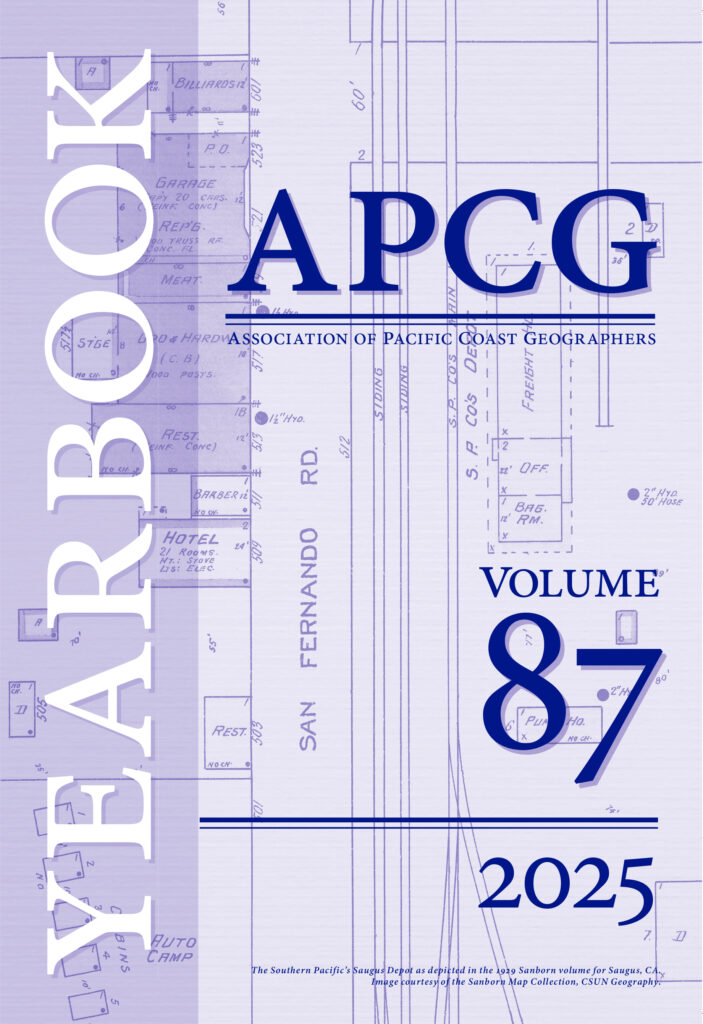
Yearbook of the Association of Pacific Coast Geographers
Volume 87 (2025)
Editor Craig S. Revels discusses the issue, annual meeting, and cover, stating:
It is my great pleasure to present the eighty-seventh volume of the Yearbook of the Association of Pacific Coast Geographers. Looking back at the first volume of the Yearbook, published in 1935 as the proceedings of the inaugural meeting of the Association, it is remarkable how encompassing and occasionally eclectic our collective endeavors have remained throughout our long history, and I believe each new volume reflects that tradition. As always, in addition to the usual selection of original research, this volume highlights our well-hosted 2024 gathering in Arcata, California. At that meeting, Fernando Bosco’s Presidential Address introduced us to the concept of gastro poles, a novel adaptation of the classic growth pole theory of economic development. Carefully exploring the relationships between food, gentrification, and place identity in Buenos Aires, he shows us how food-led development has reshaped the urban fabric and has become entwined with larger questions of identity for residents and tourists alike.
Find this introduction, research articles, biographies, book reviews, meeting reports, awards, abstracts, and more at Project MUSE.