





Asian Perspectives
Volume 64, Number 2 (2025)
The Editor’s Note introduces this issue as written by Julie Field, Francis Allard, Bérénice Bellina-Pryce, and Cristina Castillo Cobo stating:
Asian Perspectives highlights leading research in archaeology, ethnoarchaeology, and biological anthropology in Asia and the Pacific Islands. Volume 64, Issue 2 of Asian Perspectives offers four articles on the ancient past of Asia and Island Southeast Asia. Our lead article (Zhang) focuses on the evidence for social complexity and militarism in the central plains of China. This is followed by an analysis of ritual activity as indicated by bronze manufacture at the site of Sanxingdui in southwest China (He). This issue’s final two articles cover research on Hoa Lu’s urban landscape, a major historical city in Vietnam (Vo), followed by a study of possible crocodile predation on humans and the symbolic behavior of maritime hunter-gatherers in East Timor (Bacon and Galipaud). The concluding section includes four book reviews spanning South and Southeast Asia, from the interpretation of rock art and origins of agriculture in India to the development of maritime cultures in Vietnam.
Our hard copy subscribers will notice that many of the figures in this issue of Asian Perspectives have been printed in color. This is the first of a three-issue trial run intended to test whether it will be financially feasible to continue printing in color without charging authors subvention fees, so future issues may retain this configuration. Of course, the digital version of every issue (published on Project MUSE) always contains color figures.
Find this introduction, articles, book reviews, and more at Project MUSE.

Biography
Volume 47, Number 2 (2024)
Author Cynthia Franklin starts this issue in the Editor’s Note stating:
The sending off of this issue to press is bittersweet. It is the last issue that has been fully in the hands of Paige Rasmussen. Paige assumed the position of Managing Editor for Biography in 2018. For the past seven years, she has brought to Biography her superb editing and design skills. Consider, for example, the award-winning special issue on Graphic Medicine! She also has managed the Center for Biographical Research—a job with many moving parts—with patience, sensitivity, and extraordinary competence. Paige has done everything from running workshops for our special issues, to copyediting, to weighing in on submissions, to communicating with authors, to managing our budget and finances, to navigating often byzantine university bureaucracy to keep the journal running, to supervising our Graduate Assistants, to tracking our readership, to running our socials, to overseeing our Brown Bag Biography series—and more. Paige was a dream for the rest of the Biography staff to work with, and the losses—personal and professional—that attended her move to Chicago were softened for us as she has generously continued to work in a freelance capacity. And our friendship will surely continue once her work for the journal concludes. This is the final issue that will be fully in her hands, although she is continuing to help during this time of transition as we celebrate the arrival of Laura Dunn, who has returned home to Hawai‘i from the San Francisco Bay area to serve as our new Managing Editor. We look forward to introducing Laura in the editor’s note to the next Biography issue.
Find this introduction, open-forum articles, postscript commentary, biographies, translations more at Project MUSE.

CHINOPERL
Volume 44, Number 2 (2025)
Special Issue: Soundscapes of Twentieth-Century China
Edited by Andrea S. Goldman and Jing Shen
Andrea S. Goldman introduces this special issue stating:
CHINOPERL authors and readers have long paid attention to the sonic dimensions of Chinese oral and performing literature. The oral in such literature, after all, implicitly presumes a listener who apprehends and is aurally engaged (or not) by the vocal and/or instrumental artistry of the performer. Much of this concern with the oral and aural component of performance was shaped by the precocious interdisciplinarity of the journal from its inception in 1969, which put into conversation scholarship on Chinese literature, performance, ethnomusicology, and history. But if the sounds of oral and performing literature in past issues of the journal have been frequently noted, their documentation has sometimes been more descriptive than analytical, focused on the signature Chinese sonic characteristics and musical or vocal conventions of the many varieties of opera, storytelling, ballads, or folk songs.
The more recent interdisciplinary approach of sound studies, or sound history, emerging in the 1990s and 2000s, differs from sound as an object of description in that—although still borrowing from (ethno)/musicology—it blurs the distinction between music and sound; or rather, it resists privileging music over all other sounds. I have neither the space nor the expertise to narrate a full history of the development of sound studies across all fields (or even for research on China), but here I will tease out three strains in this scholarship that will help to set the stage, so to speak, for the essays that follow.
Find this introduction, research articles, postscript commentary, research notes, memoriams, and more at Project MUSE.

Journal of the Southeast Asian Linguistics Society
Volume 18, Number 2 (2025)
Tonal Geography of the Southern Thai Dialects
Ratchadaporn Phonyarit
Ablaut Reduplication in Javanese
Grace B. Wivell
A Four-Way Distance Contrast in Takbanuaz Bunun Demonstratives
Rik de Busser
Mergers of Voiced and Voiceless Consonants in the Siamese, Lanna and Lao Languages
Maria Timpika Chomcha
Reciprocal Constructions in Bodo
Aleendra Brahma
These research papers, data papers, book reviews, and more can be found at eVols.
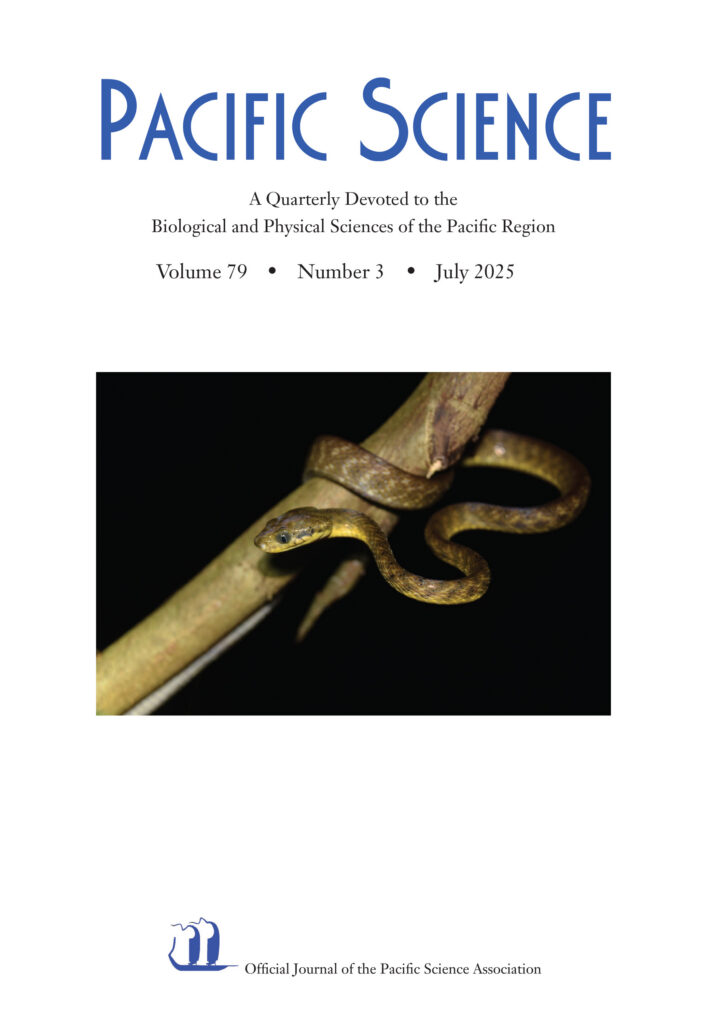
Pacific Science
Volume 79, Number 3 (2025)
A Comparative Evaluation of Bait Types Taken by Brown Treesnakes or Other Nontarget Species, Including Ants
Melia G. Nafus, Amanda A. Reyes, Bea S. F. Daria, Christiana-Jo C. Quinata, and Ross Miller
Biology and Impacts of Pacific Islands Invasive Species. 19. Anoplolepis gracilipes (Hymenoptera: Formicidae)
Monica A. M. Gruber, Allan R. Burne, and Meghan Cooling
Radiocarbon Ages of Extinct Terrestrial Crabs (Geograpsus severnsi) from Late Holocene Dunes at Waihe’e, Maui, Hawaiian Islands
Patrick V. Kirch and Scott Fisher
Records of Helminth Parasites at Archaeological Sites in the New Guinea Highlands, from c. 18,000 Yr B.P., Suggest Late Holocene Presence of Dogs and Pigs
Mark Horrocks, Tim P. Denham, and Bronwen Presswell
Temporal Size Changes in Archaeological Fishbone Assemblages from Tikopia, Eastern Solomon Islands: Implications for Long-Term Human–Reef Ecosystem Interactions
Elizabeth M. Perez and Patrick V. Kirch
Find these research articles and more at Project MUSE.

Philosophy East and West
Volume 75, Number 4 (2025)
Awake While Dreaming: Reconciling Advaita Vedānta’s Embodied Liberation through Lucid Dreaming
Neil Dalal
How Not To Do Things With Others: A Buddhist Account of Shared Agency
Oren Hanner
In Search of an Ethics for Plants: A Brief Exploration of the Early Writings of Jainism and Buddhism
Pragati Sahni
Epistemic Blinkering: Reflections on Fraser’s Discussion
Winnie Sung
The Place of Zhuangzi and Xunzi in Fraser’s Late Classical Chinese Thought
Ellie Hua Wang
Find these articles, discussions, book reviews, and more at Project MUSE.

Philosophy East and West
Volume 76, Number 1 (2026)
Special Issue: Exploring Seongho Yi Ik’s Theory of Emotions
Guest Editor Youngsun Back talks about the Special Issue stating:
Yi Ik 李瀷 (1681–1763), known by his pen name Seongho 星湖 (Starry Lake), was a prominent figure in Korean Confucianism. Although he is less well known to English-speaking audiences than Yi Hwang 李滉 (1501~1571, known as Toegye 退溪), Yi I (李珥, known as Yulgok 栗谷), and Jeong Yak-yong 丁若
鏞 (1762–1836, known as Dasan 茶山), Seongho occupies a vital place in the intellectual lineage of Korean Neo-Confucianism. As this special issue demonstrates, he stood at the center of the dynamic development of Korean Confucian thought, serving both as a key intermediary between the philosophical legacies of Toegye and Yulgok and as a significant bridge between Toegye and Dasan.
Seongho also played a crucial role in shaping the distinctive character of late Joseon Confucianism, particularly through his contributions to the intellectual current known as Practical Learning (Silhak 實學). This intellectual trend sought to move beyond abstract metaphysical speculation, emphasizing instead moral cultivation grounded in lived experience, as well as a commitment to empirical inquiry, social reform, and effective governance. Another major factor that gave Seongho’s philosophy its innovative character was the influx of Western Learning (Seohak 西學), which had begun circulating in Korea during his time. Drawing on a wide range of intellectual resources, Seongho developed a form of Korean Confucianism that remained rooted in Neo-Confucian thought yet open to new ideas, marking him as a pivotal thinker in the unfolding of Korea’s intellectual tradition.
Find this introduction, articles, book reviews, and more at Project MUSE.
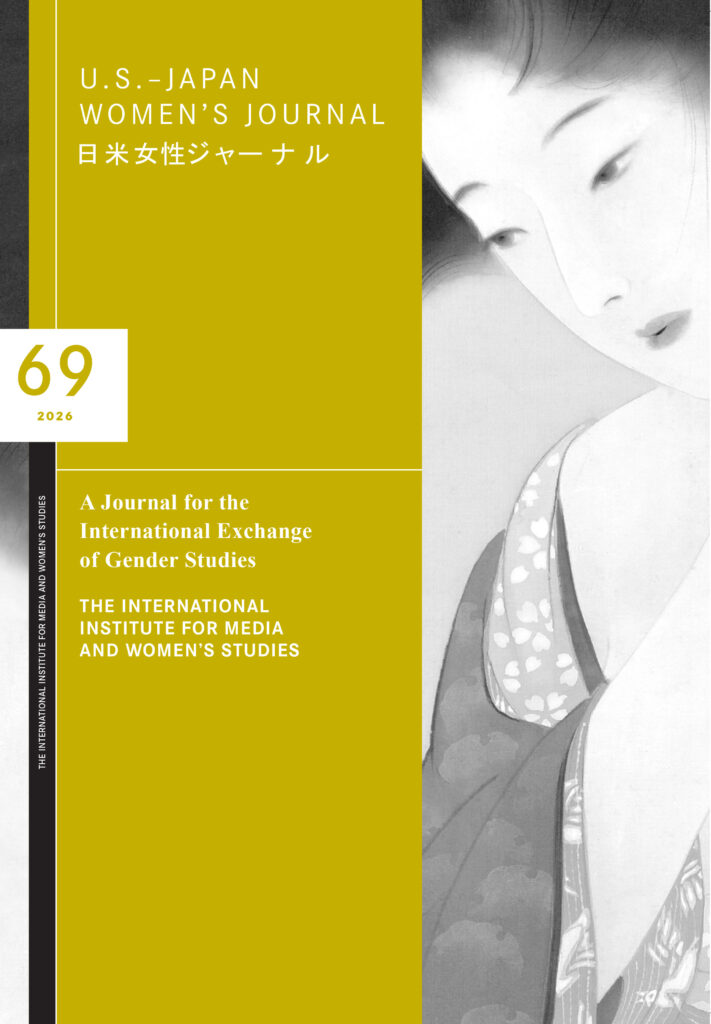
U.S.-Japan Women’s Journal
Volume 69 (2026)
Elise Grilli (1906-1969): Pioneer American Historian and Critic of Japanese Art
Christine M.E. Guth
New Wave Women: Brothel Prostitutes’ Participation in Public Health in 1950s Tokyo
Aoi Saito
Selected Essays from Mukōda Kuniko’s Chichi no wabijō (Father’s Letter of Apology)
Mukōda Kuniko, Rajyashree Pandey, and Teresa Castelvetere
Find these articles and more at Project MUSE.