




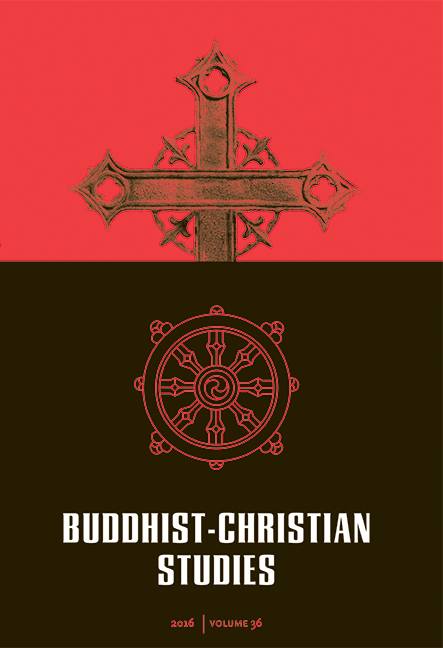
The latest issue of this annual journal devoted to Buddhism and Christianity and their historical and contemporary interrelationships feature the following peer-reviewed works:
Old Buddhist Texts: New Womanist Though
- In the Company of Friends: Womanist Readings of Buddhist Poems
by Melanie L. Harris - Freedom on My Mind: Buddhist-Womanist Dialogue
by Keri Day - Practice in Buddhist-Womanist Thought
by Carolyn M. Jones Medine - Womanist Approaches to the Therīgathā and the Therīgathā’s Influence on Womanism
by Linda E. Thomas - Wombu: An Intellectual Exercise in Womanist and Buddhist Reading
by Tracey Elaine Hucks
Liberation Theology and Engaged Buddhism
- Introduction to Liberation Theology and Engaged Buddhism
by Kristin Johnston Largen - Through the Eyes of Auschwitz and the Killing Fields: Mutual Learning between Engaged Buddhism and Liberation Theology
by Sallie B. King - Expanding the Cultivation and Practice of Love and Compassion in our Suffering World: Continuing the Dialogue between Liberation Theologians and Engaged Buddhists
by Karen B. Enriquez - Confronting the “Sin” out of Love for the “Sinner”: Fierce Compassion as a Force for Social Change
by John Makransky - Liberation Theology and Engaged Buddhism: Challenging Each Other, Learning from Each Other
by Paul F. Knitter - A Buddhist and Christian on the Way to Carnegie Hall: A Responseby Ruben L. F. Habito
Plus articles on Buddhist-Christian Dialogues, News and Reviews, and Book Reviews.
Find the full text of the issue at Project MUSE
About the Journal
Buddhist-Christian Studies is a scholarly journal published annually by University of Hawai‘i Press. It presents research papers, book reviews, and news items on Buddhism and Christianity, their interrelation, and comparative study based on historical materials and contemporary experience.
Subscriptions
Annual subscriptions for both individuals and institutions available here.
Submissions
The materials selected for publication will be balanced between historical research and contemporary practice, and, where possible, they should employ analytical and theoretical tools and be set within the framework of our shared human history. See the submission guidelines here.