




Asian Theatre Journal
Volume 42, Number 2 (2025)
This issue includes as Special Section: South and Southeast Asian Ecotheatre with an introduction by Catherine Diamond who discusses the issue stating:
Ecology, the science of the complex web of relationships between organisms and their environment, became codified in the mid-nineteenth century. It originally centered on biological mutualism and excluded humanity, yet it has since been appropriated by the arts and humanities to foreground human–nonhuman relations. Derived from the Greek oikos, meaning household or hearth, or in a broader sense, “home,” this derivation might make it closer to cultures that do not think of nature in exclusively scientific terms. But even returning to ecology’s original scope, for rural and economically marginalized communities, ecological awareness paired with protecting their proximate environments is often a matter of immediate physical and cultural survival, while for those in the cities, it can be a more abstract global ideology that insists current economic and production systems are at odds with the planet’s capacity to thrive and provide. This ATJ special volume includes essays exploring performances dealing with both the rural and urban perspectives toward human-wrought environmental changes.
Find this introduction, translations, emerging scholars, book reviews and more at Project MUSE.
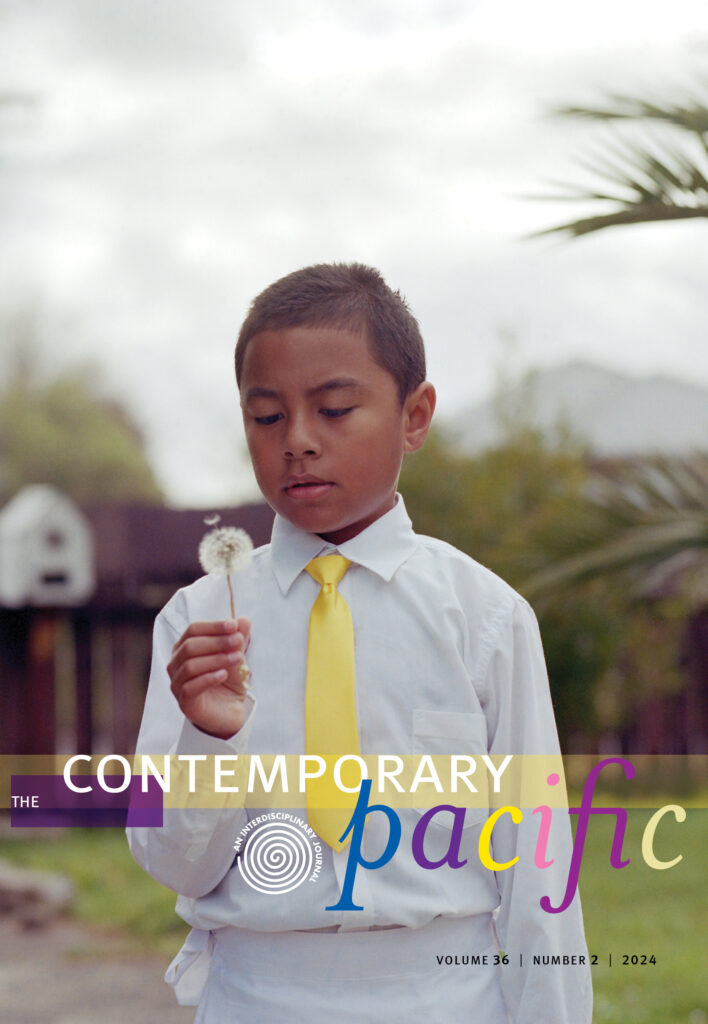
Contemporary Pacific
Volume 36, Number 2 (2024)
This latest issue features artwork by Edith Amituanai. Amituanai’s work is discussed in About the Artist stating:
Edith Amituanai is a New Zealand–born Samoan photographer working from Tāmaki Makaurau. From interiors to driveways to communities, Amituanai’s practice is concerned with environments that shape who we are. Her ongoing study of the Samoan transnational community and their homes has taken her across New Zealand, Sāmoa, France, Italy, Canada, and the United States. In 2008, Amituanai was nominated for the Walters Prize for her series Déjeuner, which examined a new diaspora: expatriate New Zealand–Samoan rugby players living and working in France and Italy. Her first foray outside of her Samoan community was the series La Fine Del Mondo (2009-2010), which focused on helping the Lai family, Chin refugees from Myanmar, settle into their new home in Massey, West Auckland. Amituanai’s interest in embedding herself in the environment she is working in means she often takes on different roles in the community, from sports team manager and youth worker to freelance photographer.
As a teaching artist, she has led a variety of workshops for art galleries, community groups, and institutions. In 2017, she undertook a six-week residency at Te Kura o Kimi Ora in Flaxmere, which resulted in Keep on Kimi Ora, an exhibition at Hastings Art Gallery featuring photographs taken by students of the school. Amituanai also taught photography in secondary schools in New Zealand as part of the Ministry of Education’s Creatives in Schools program.
Find these articles, book reviews, media reviews, About the Artist, and more at Project MUSE.
Journal of the Southeast Asian Linguistic Society
Volume 18, Number 2 (2025)
Ablaut Reduplication in Javanese
Grace B. Wivell
Tonal Geography of the Southern Thai Dialects
Ratchadaporn Phonyarit
Reframing Pre-Modern Language Contact through Trade in Eastern Indonesia: Javanese Linguistic Influence in the Moluccas
Antoinette Schapper and Maria Zielenbach
A Phonological Sketch of Uruangnirin, an Endangered Austronesian Language of Eastern Indonesia
Eline Visser and Artúr Stickl
Review of the Syntax of Vietnamese Tense, Aspect, and Negation by Trang Phan
Trần Phan
Reciprocal Constructions in Bodo
Aleendra Brahma
Find these research papers, data papers, book reviews, and more at EVols.
Journal of World History
Volume 36, Number 2 (2025)
Global History and the Measures of Early Modern Technology: Europe, East Asia, and the Case of Smoothbore Ballistics*
Hyeok Hweon Kang
Beating the Odds: A Survival Story of Chinese Immigrants in Nicaragua*
Rudolph Ng
“Illustrative Cases of Hereditary Degeneracy”: The Use of Family Studies to Support New Zealand’s Eugenic Narrative in the 1920s
Delwyn Blondell
“A One-Woman Expedition to Get to Know Tanzanian Women”: State Socialist Women’s Travelogues about Africa in the 1960s–80s
Réka Krizmanics
Strategies of Belonging in the Bandung Era: Diasporas and Cold War Asia
Chien-Wen Kung, Sayaka Chatani, and Taomo Zhou
Read these research articles, reviews, and more at Project MUSE.
Philosophy East and West
Volume 75, Number 3 (2025)
This issue has an Special Feature: The Life and Work of J.N. Mohanty: A Philosophical Tribute. Berger remembers Mohanty in the Introduction titled Some Memories of my Teachers, J.N. Mohanty stating:
It has been a little more than two years since I, along with many others, learned of the death of a giant in modern philosophy, and the loss still registers, as classical Indian Nyāya philosophers would say, the presence of his absence. Equally significant for his illumination of the thought of Edmund Husserl and of debates in the classical Indian tradition, that giant was Jitendranath Mohanty (1928–2023). I, along with several generations of people in these fields, in India and the United States, had the unmatched privilege and good fortune of being his student. I have written and done conference presentations about my learning experience from Mohanty and about his works in other venues, and so the editors of Philosophy East and West and this special issue have asked me to include my remembrance of him here.
Find this Special Introduction, articles, book reviews, and more at Project MUSE.
U.S.-Japan Women’s Journal
Volume 68 (2025)
No More Longing in Vain: How to Write Women Back into Man’yōshū
Danica Truscott
Mediating Feminism: Newspaper and Magazine Coverage of Sartre and Beauvoir in Japan
Julia C. Bullock
Imperial Women’s Travel Writing in the Japanese Colonial Magazine Taiwan fujinkai (Taiwan Women’s World) 1934-1939
Anne Sokolsky
Find these articles and more at Project MUSE.