




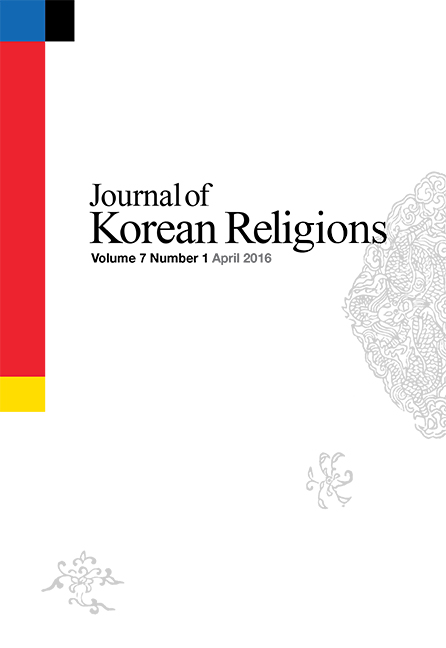
Journal of Korean Religions vol. 7, no. 1 features the following articles by scholars:
Research Articles
- Perception of Monastic Slaves by Scholar-Officials and Monks in the Late Koryŏ and Early Chosŏn Periods
by Sung-Eun Thomas Kim - Views on Buddhist Precepts and Morality in Late Koryŏ
by Sem Vermeersch - Does the Neo-Confucianism of the Chosŏn Dynasty belong to the Cheng-Zhu School?: Rethinking the Intellectual History of Chosŏn through the Philosophical Tradition of Yi I (1538–1584)
by Weon-jae Jeong
Special Series: Religious Thinks of Modern Korea
- The Philosophy of Sŏn Master T’oeong Sŏngchŏl (1912–1993)
by Bernard Senécal S.J.
Book Reviews
- Death, Mourning, and the Afterlife in Korea: From Ancient to Contemporary Times. Charlotte Horlyck and Michael J. Pettid.
reviewed by Laurel Kendall - Building A Heaven on Earth: Religion, Activism, and Protest in Japanese-Occupied Korea. Albert L. Park.
reviewed by Hwansoo Kim - Korea’s Great Buddhist-Confucian Debate: The Treatises of Chŏng Tojŏn (Sambong) and Hamhŏ Tŭkt’ong (Kihwa). Korean Classics Library: Philosophy and Religion. Translated and with an introduction by A. Charles Muller.
reviewed by Sem Vermeersch - Han’guk chŏnjaeng kwa kidokkyo [The Korean War and Protestantism]. Yoon Jeong Ran.
reviewed by Kyuhoon Choa
Find the full text of the issue at Project MUSE
 About the Journal
The Journal of Korean Religions is the only English-language academic journal dedicated to the study of Korean religions. It aims to stimulate interest in and research on Korean religions across a range of disciplines in the humanities and social sciences. Launched in 2010 by the Institute for the Study of Religion at Sogang University in Korea, it is peer-reviewed and published twice yearly, in April and October.
Subscriptions
Annual subscription for both institutions and individuals. Click here to subscribe.
Submissions
The journal invites contributions from senior and junior scholars researching on any aspects of Korean religions from a wide range of perspectives, including religious studies, philosophy, theology, literature, folklore, art, anthropology, history, sociology, political science, and cultural studies. Click here for more submission information.