




The University of Hawai‘i Press is honored to join the University of Hawai‘i at Mānoa’s Center for Korean Studies in celebrating Korean Studies journal on its 50th year of publication. Korean Studies has been the oldest continuously published academic journal exploring Korean studies outside the Korean peninsula. The journal has proudly presented research articles, review articles, commentaries, and book reviews on Korea-related topics since 1977. With its 50th issue, Korean Studies will shift from an annual to a semiannual publication. Korean Studies: Global Research & Critique, Volume 50, Number 1 will debut in April 2026.
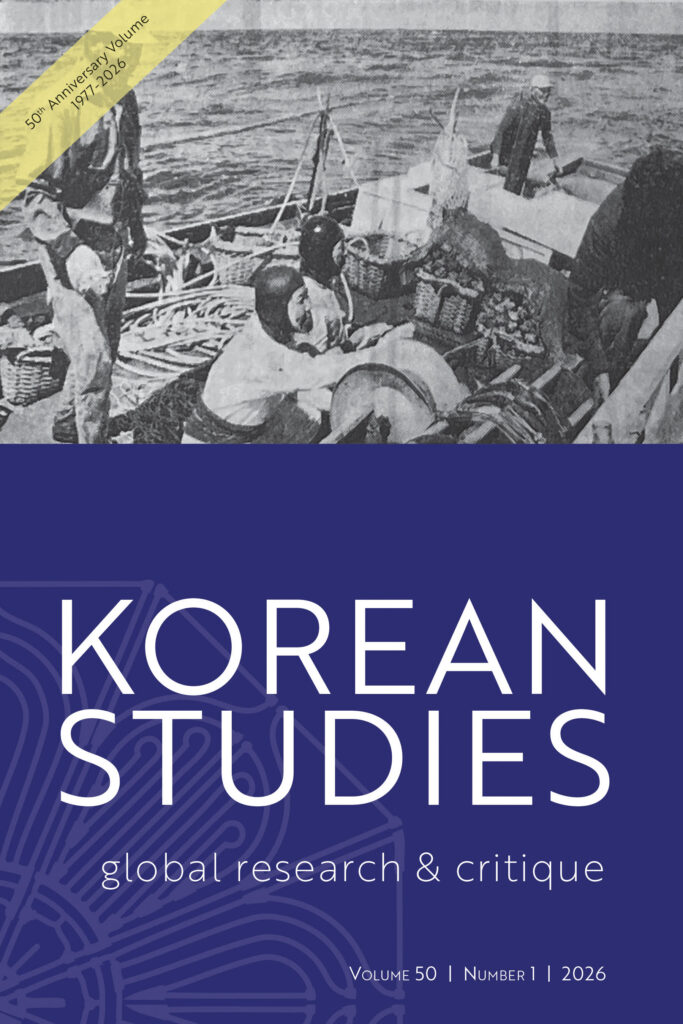
Editor Cheehyung Harrison Kim recognizes Korean Studies history, new title, and cover in the introduction stating:
This issue marks the fiftieth year of Korean Studies. We are the oldest continuously published academic journal in the field of Korean studies existing outside the Korean peninsula, the first issue coming out in mid-1977. The field today has many excellent journals, and we are fortunate and proud to have stayed relevant for the past five decades…
As the journal embarks on another fifty years, we unveil major changes in the name, design, and formatting. The journal is now called Korean Studies: Global Research & Critique. The cover features an elegant font on a matte navy background, and each issue will showcase an image from one of the articles. The original symbol of the lotus wadang (the circular roof-end tile) has been preserved, in a more integrated way. We are also going two issues per year, with the Fall issue reserved for a special issue.
A major change in formatting is that we are bringing back the footnotes. I am sure many researchers will welcome the return of footnotes.
This commemorative issue features four research articles (by Sang Mee Oh, Kyounghwa Lim, Wonseok Lee, and David Kwon), a commentary (by Eun-Young Kim), three book reviews (by Yejun Kweon, Kyu-hyun Jo, and Holly Stephens), and the reprint of Pihl’s 1977 article. These pieces represent the robustness and sophistication of what the journal strives to achieve in each issue.
Fifty years ago, the inaugural editor Dae-Sook Suh wrote that the
journal is dedicated to promoting “interdisciplinary and intercultural approaches to Korean studies.” Our new name reflects this original vision. The journal renews its pledge to publish excellent research on Korea by scholars from across the world.
Volume 50
Table of Contents
Editor’s Note
Cheehyung Harrison Kim
Articles
Engineers of the Human Soul: North Korean Literature Today
Marshall R. Pihl
Carving Out Space for Korean History: Contributions of Korean Scholars in East
Asian Studies in the United States, 1955–1965
Sang Mee Oh
Women Divers Resisting Oppression: A Brief History of Jeju Divers and Their
Representations in North Korea’s Literature, Performance Art, and Screen Culture
Kyounghwa Lim
From Policy to Pop: Navigating South Korean Cultural Policies and Their Impact on
Korean Popular Music
Wonseok Lee
Korea’s Path of Liturgical Inculturation: Ancestral Rites in Confucian-Christian
Interplay, Social Change, and Women
David Kwon
Commentary
Coming (Out) to Terms with Queerness in Korea: Language Matters
Eun-Young Julia Kim
Book Reviews
Park Nohae’s Dawn of Labor
Reviewed by Yejun Kweon
Vladimir Tikhonov’s The Red Decades: Communism as Movement and Culture in Korea, 1919–1945
Reviewed by Kyu-hyun Jo
Andre Schmid’s
North Korea’s Mundane Revolution: Socialist Living and the Rise of Kim Il Sung,
1953–1965
Reviewed by Holly Stephens
Volume 50 can be found on Project MUSE in April 2026.
Please also visit our UH Press Korean Studies site for more information on this fantastic journal!