




Journal of World History volume 28, numbers 3&4 is a special double issue guest edited by Tracey Rizzo on Gender and Empire. It includes more than 400 pages of articles and book reviews from world history scholars.
From the Editor’s Introduction:
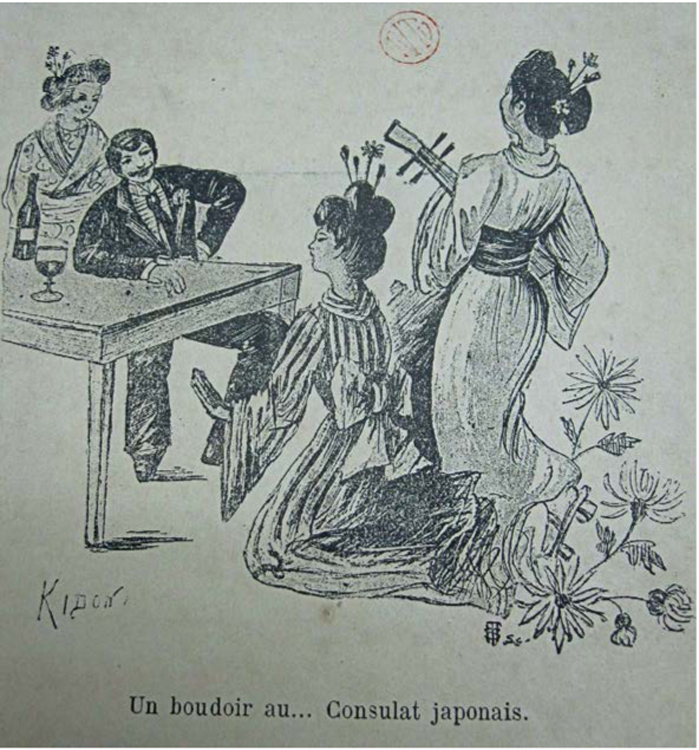
Gender and Empire as a subfield of world history goes beyond the study of the men and women who made and unmade empires. Intimacies generated ties that facilitated or impeded the modernization of family and nation, demarcating contact zones. Bodies–adorned, fetishized, public–displayed and negotiated imperial relations. Detritus, the material remains of empire and intimacy, lodged itself in the institutions and discourses of modernity. When world historians talk across boundaries and borders, we situate disjointed ruins in broader trends and patterns, without which they are mere curiosities. Assembled here: a Chinese scalp; a silver buckle from Malaya; a bawdy cartoon from Hanoi; a hybrid recipe from Nigeria; dossiers from Lebanon and El Salvador; government orders promoting or suppressing prostitution… Confined to a national or even imperial history, such fragments do not tell us anything about coloniality. Here they do.
Articles
- Domesticating Labor: An Illicit Slave Trade to The British Straits Settlements, 1811–1845 By Shawna Herzog
- Sex and the Colonial City: Mapping Masculinity, Whiteness, and Desire in French Occupied Hanoi By Michael G. Vann
- Japanese American Migration and the Making of Model Women for Japanese Expansion in Brazil and Manchuria, 1871-1945 By Sidney X. Lu
- Too Many Cooks Spoil the Soup: Conflicting British Nutrition Education Policy Approaches and African Responses By Lacey Sparks
- Migration, Masculinity, and Mastering the Queue: A Case of Chinese Scalping By Rachel K. Bright
Plus five more articles, 13 book reviews, books received, and the volume index.
Find the full text of the issue at Project MUSE
 About the Journal

The Journal of World History publishes research into historical questions requiring the investigation of evidence on a global, comparative, cross-cultural, or transnational scale. It is devoted to the study of phenomena that transcend the boundaries of single states, regions, or cultures, such as large-scale population movements, long-distance trade, cross-cultural technology transfers, and the transnational spread of ideas.
Subscriptions
Individual subscription is by membership in the World History Association. Institutional subscriptions available through UH Press.
Submissions
The Journal of World History is proud to introduce a new article and peer review submission system, accessible now at at jwh.msubmit.net.