




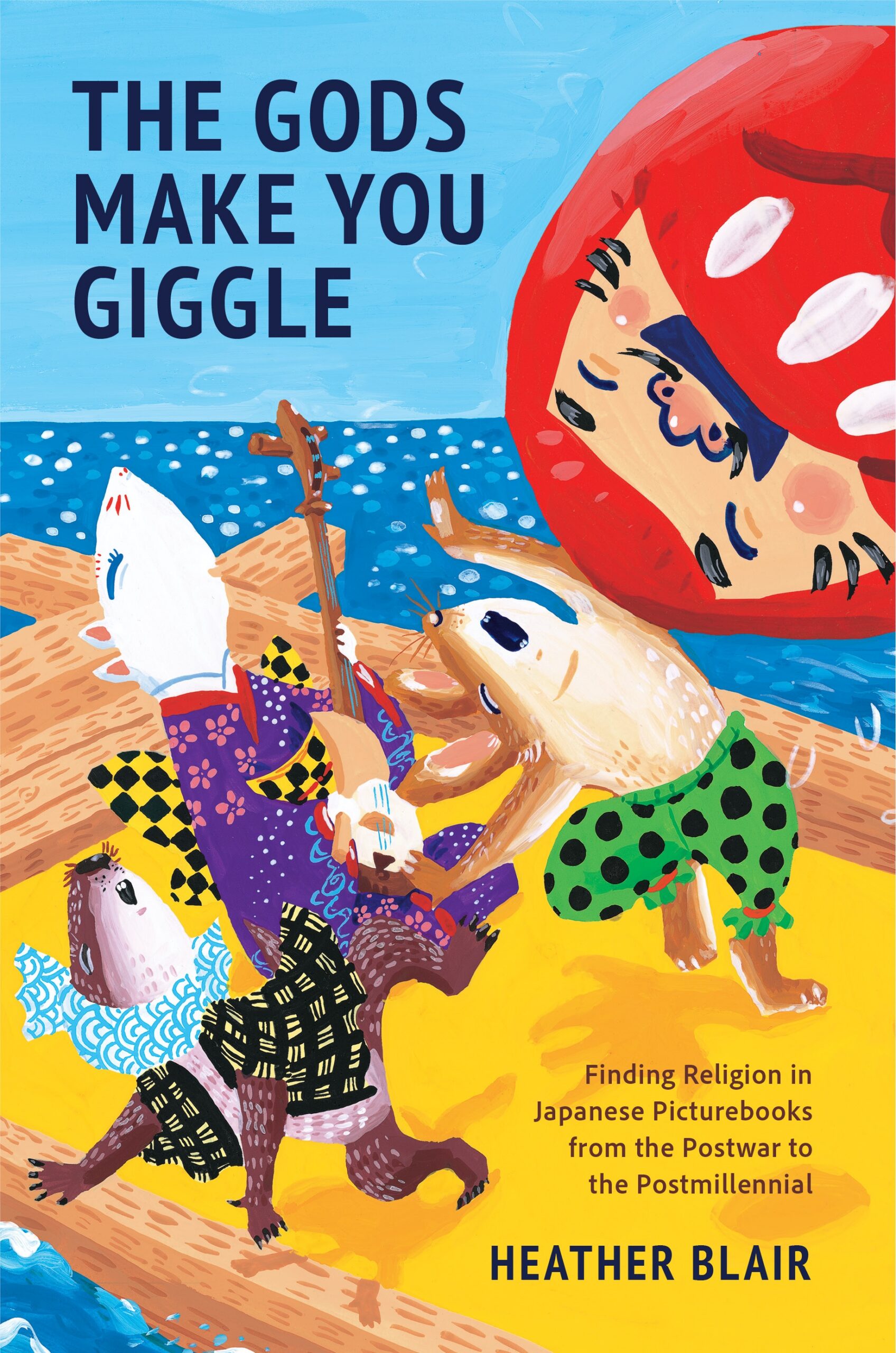
The Gods Make You Giggle: Finding Religion in Japanese Picturebooks from the Postwar to the Postmillennial
- About the Book
-
Incisive and fun, The Gods Make You Giggle draws readers into the world of Japanese picturebooks, where the sublime can erupt from the everyday and hell may just turn out to be hilarious. Juxtaposing analyses of folksy retellings, midcentury classics, and avant-garde provocations, this study crafts dynamic new perspectives on religion and history while also showcasing the richness and sophistication of one of the world’s most vibrant children’s literatures.
Because Japan’s mainstream picturebook repertoire eschews overt engagement with religious doctrines and institutions, most authors, illustrators, and critics see it as simply and self-evidently non-religious. The Gods Make You Giggle turns that thinking on its head. Taking its cues from picturebooks themselves, it frames religion as a ground for play, open to irreverence, ambivalence, surprise, and transformation. In turn, it shows that religion, reconceptualized in a ludic frame, energizes the picturebook repertoire; in fact, many adults now describe picturebooks as sources of truth, consolation, and even grace.
In addition to reimagining what religion might look like, The Gods Make You Giggle intervenes in cultural history, Japanese studies, and the study of children’s literature in distinctive ways. By analyzing the interplay of image and text, which proves fundamental to the operation of picturebooks, it brings methods from the study of both literature and visual culture to bear on historical analysis. By charting a longitudinal account of the years extending from the postwar to the postmillennial, it brings the history of Japan forward, into the very recent past. And by bringing Japanese materials into dialogue with the English-language study of children’s literature, which has to date focused almost exclusively on North America and Europe, it lays the groundwork for future research and responsible comparison.
- About the Author(s)
-
Heather Blair, Author
Heather Blair is associate professor in the Department of Religious Studies at Indiana University Bloomington.
- Reviews and Endorsements
-
- Casual readers of the news know three things about contemporary Japan: The birth rate is declining, the economy is stagnant, and trust in religious institutions is waning. One of the brilliant things this book does is take these three bulls by their horns and place them front and center. It thinks through the statistics as intertwined realities constitutive of modern Japanese lived reality. Blair makes a wonderful argument: that picturebooks function as a recuperative technology—for adults as much as children—making a ‘safe’ kind of religion accessible and providing an ethical and emotional bulwark against the alienations of modern capitalism.
—Charlotte Eubanks, The Pennsylvania State University - A brilliant and ambitious book that brings together religion, picturebooks, and childhood in Japan. It describes how Japanese picturebooks from between the 1950s and today, in text and image, ‘do religion’ while also entertaining, educating, inspiring, and amusing children and adults. This is original scholarship at its best: It will undoubtedly unsettle ideas about how religion works rather than what it is, challenge the trivialization of children and children’s books in a range of scholarly fields, and push us to consider children’s literature simply as literature.
—Sabine Frühstück, University of California, Santa Barbara
- Casual readers of the news know three things about contemporary Japan: The birth rate is declining, the economy is stagnant, and trust in religious institutions is waning. One of the brilliant things this book does is take these three bulls by their horns and place them front and center. It thinks through the statistics as intertwined realities constitutive of modern Japanese lived reality. Blair makes a wonderful argument: that picturebooks function as a recuperative technology—for adults as much as children—making a ‘safe’ kind of religion accessible and providing an ethical and emotional bulwark against the alienations of modern capitalism.