




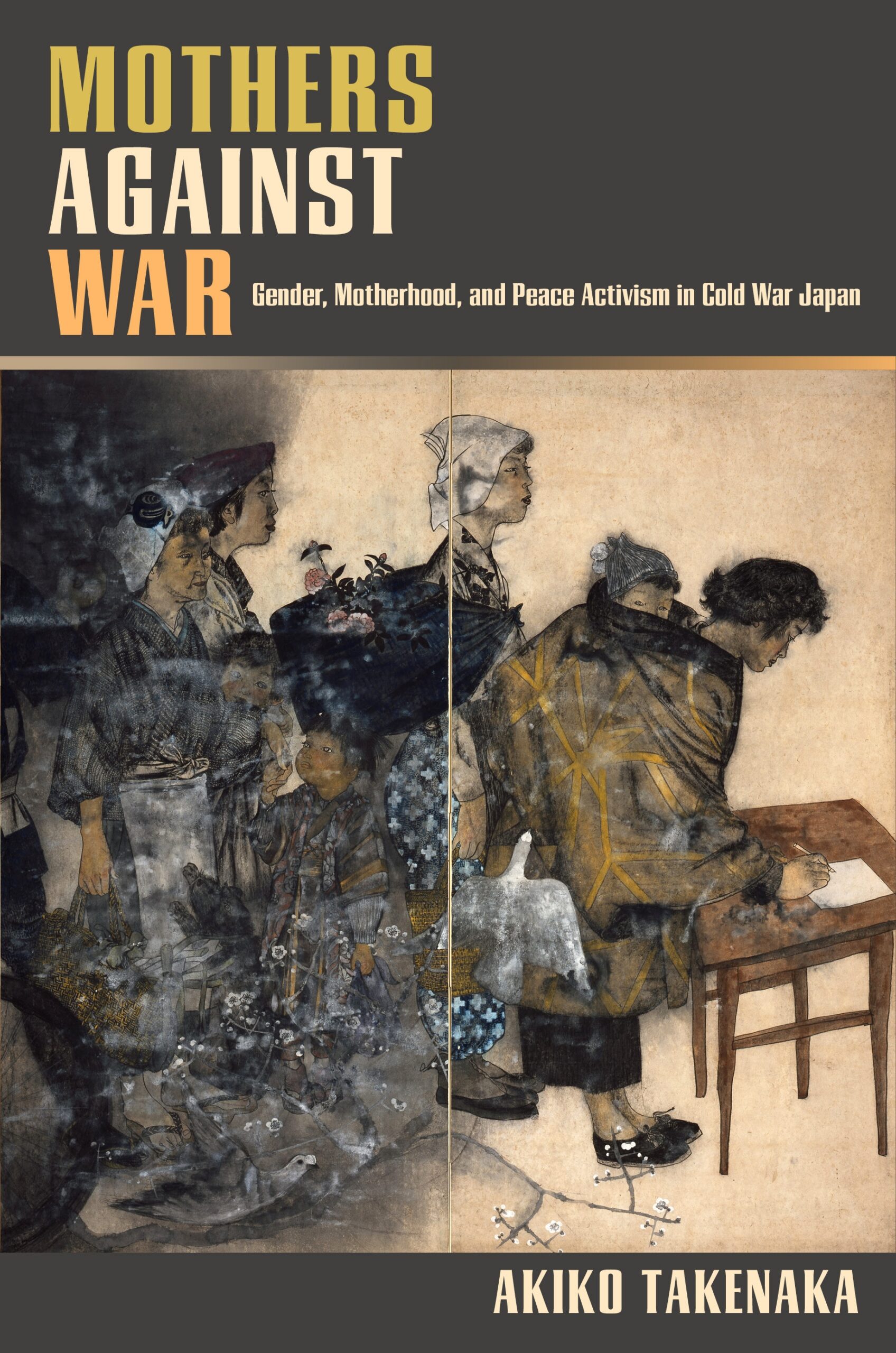
Mothers Against War: Gender, Motherhood, and Peace Activism in Cold War Japan
- About the Book
-
Mothers Against War examines the shifting relationships among motherhood, peace activism, and women’s rights in the decades following Japan’s defeat in 1945. With a focus on the concept of bosei, generally understood to be the “motherly” qualities that are supposedly inherent to women, the book illuminates how popular perceptions of the mother, the child, and the mother-child relationship gradually evolved to create the image that mothers, more than anyone else, protect children from war. This image did not result simply from a mothers’ desire to keep their children safe, nor was it the outcome of the Japanese experience of the Asia-Pacific War in which many mothers became widowed or lost their children. Through the examination of five instances of peace activism that took place between 1945 and 1980, Akiko Takenaka argues that the maternal focus of Japanese women’s peace activism emerged from a convergence of various interests, including the security alliance between Japan and the United States, Japan’s Cold War–era political strategies, and Japanese women’s fight for increased rights. Mothers Against War demonstrates how Japanese women’s attempts to activate the concept of bosei to gain more rights also worked to confine them into domesticity. This is the first scholarly monograph to make this connection between Japan’s matricentric peace activism and the fight for women’s rights.
- About the Author(s)
-
Akiko Takenaka, Author
Akiko Takenaka is professor of Japanese history at the University of Kentucky.
- Reviews and Endorsements
-
- Mothers Against War explores topic that has not yet received a sustained treatment in the English-language scholarship, that of the construction of a link between motherhood and pacifism in postwar Japan. Based on extensive archival research, Takenaka explores the formulation of bosei and boshi to tease out the complex transition from war-supporting maternalism to postwar pacifist maternalism. The book offers critical insight into Japan’s awkward transition from a military power to an uncertain and unequal postwar peace and is a major contribution to global comparative studies on the power and pitfalls of ‘motherhood’ as a social movement strategy.
—Chelsea Szendi Scheider, Aoyama Gakuin University - Perhaps the most uncomfortable (and counter-intuitive) lesson to learn from this well-argued book is this: regardless of how natural the desire to protect one’s child from war at all costs feels to a mother, it does not inevitably translate into effective politics. . . . [Ongoing] developments—dramatic increases in the investment in defence capabilities on the one hand and the speechlessness of peace activists on the other—make the original contributions of Mothers Against War yet more important. Students of the post-Asia Pacific War era, the history of women, gender, and generations, of social and political movements, of the deceiving and seductive clarity of war, and of peace as more than the absence of mass violence, will greatly benefit from reading this book.
—Sabine Frühstück, University of California, Santa Barbara, Pacific Affairs 99:2
- Mothers Against War explores topic that has not yet received a sustained treatment in the English-language scholarship, that of the construction of a link between motherhood and pacifism in postwar Japan. Based on extensive archival research, Takenaka explores the formulation of bosei and boshi to tease out the complex transition from war-supporting maternalism to postwar pacifist maternalism. The book offers critical insight into Japan’s awkward transition from a military power to an uncertain and unequal postwar peace and is a major contribution to global comparative studies on the power and pitfalls of ‘motherhood’ as a social movement strategy.