




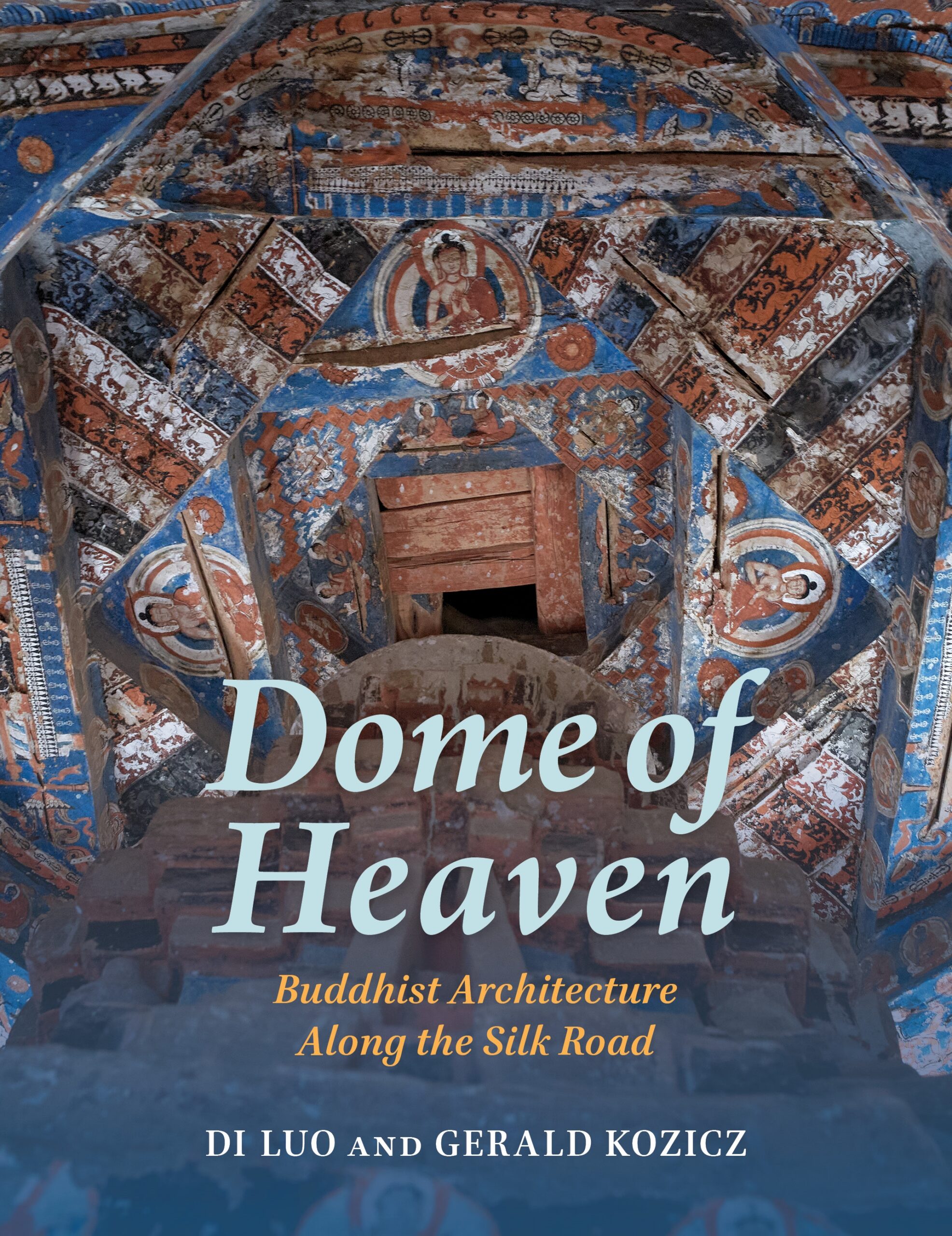
Dome of Heaven: Buddhist Architecture Along the Silk Road
- About the Book
-
Dome of Heaven enters the long-standing debate in architectural history on the origins and significance of the dome as both an idea and a building technique. Examining the material evidence and intellectual foundations of Buddhist ceilings in a trans-Eurasian context, Di Luo and Gerald Kozicz reveal the multiple genealogies and meanings of the Buddhist dome to unravel the deep-seated connections between the East and the West and the “in-between” in architectural and astronomical knowledge and practice during the first millennium.
On the Indian subcontinent, the arched shape of the dome emerged from Śākyamuni’s “fragrant chamber,” the first Buddhist temple and the embodiment of asceticism. As the Mahayana and Vajrayana schools spread across Asia along the Silk Road, this humble design evolved to incorporate increasingly complex cosmological diagrams, pictorial and calligraphic, in ceiling spaces, culminating in a mandalic universe pivoting around Mount Meru, the center of the Buddhist cosmos.
Foregrounding areas often described as “peripheries” to the great Silk Road empires, Luo and Kozicz establish a geographical framework for the Buddhist dome of heaven. They identify three major channels of transmission: the trans-Hindukush, the trans-Taklamakan, and the trans-Himalayan. Along these routes, builders traded ideas and goods like architectural models and miniatures, facilitating exchanges that shaped Buddhist domes into vessels of the ethical universe, visual and kinesthetic aids to meditation, and roadmaps to enlightenment.
Abundantly illustrated with more than eighty drawings, 3D models, maps, and photographs, Dome of Heaven offers a wealth of insights into the creation of a theological world order through spatial choreography, iconography, and pictorial storytelling.
- About the Author(s)
-
Di Luo, Author
Di Luo is Chu-Niblack Associate Professor of Art History and Architectural Studies at Connecticut College.Gerald Kozicz, Author
Gerald Kozicz is an architectural historian who specializes in the art and architecture of northern India and the Himalayan regions.
- Reviews and Endorsements
-
- This refined and sophisticated survey of Buddhist domes in major sites along the ancient Silk Road will be an excellent resource for many scholars in the fields of Asian art and architecture and Buddhist studies.
—Mariachiara Gasparini, author of Transcending Patterns: Silk Road Cultural and Artistic Interactions Through Central Asian Textile Images - By setting Central Asia at the core of its analysis, Dome of Heaven offers a new perspective on the history of Buddhist art and architecture, one that is highly original and beneficial to our reaching a deeper understanding of the development of Buddhist visual culture in interaction with architecture on the Silk Road.
—Satomi Hiyama, coauthor of Traces of the Sarvāstivādins in the Buddhist Monasteries of Kucha
- This refined and sophisticated survey of Buddhist domes in major sites along the ancient Silk Road will be an excellent resource for many scholars in the fields of Asian art and architecture and Buddhist studies.