




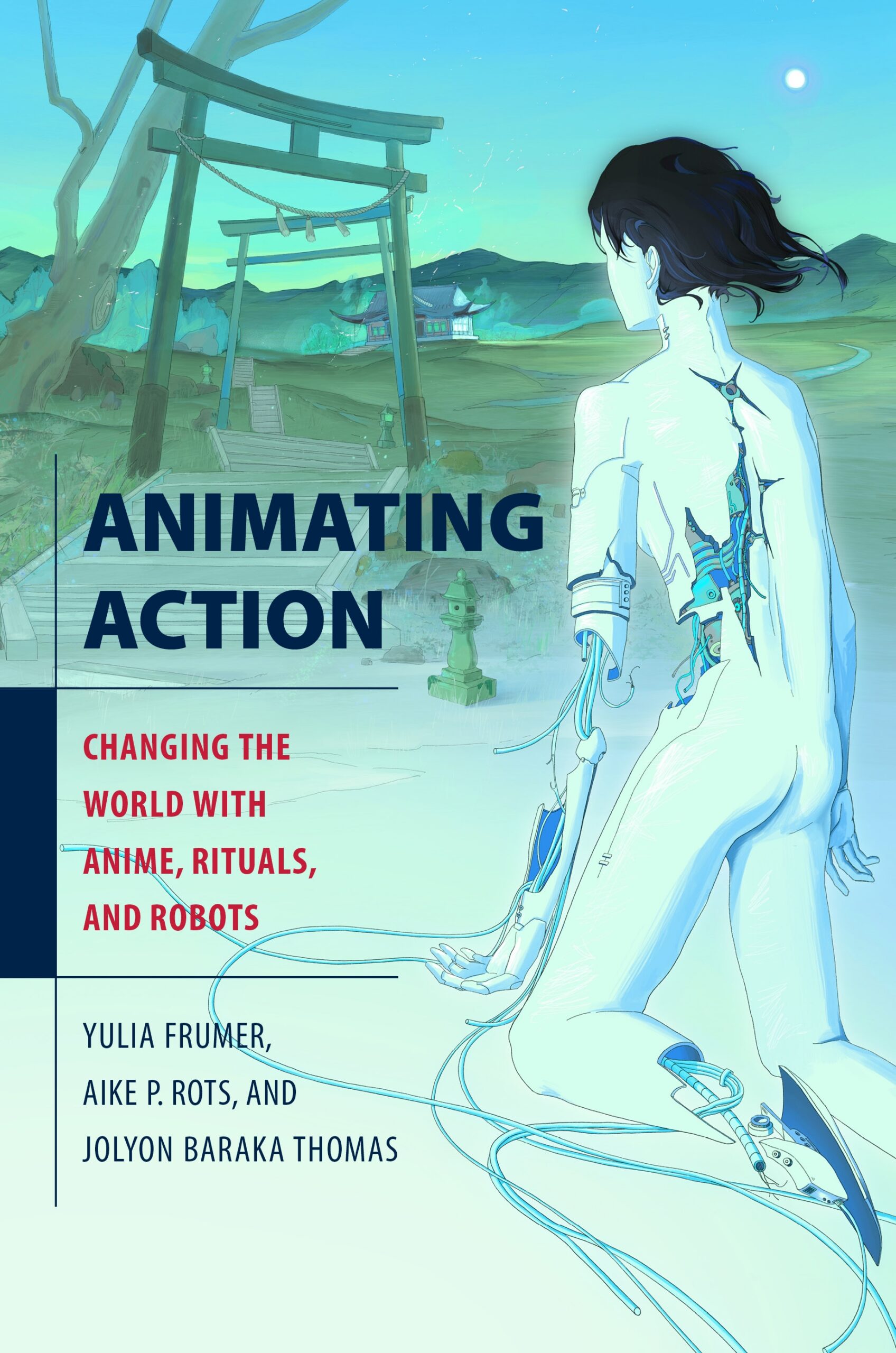
Animating Action: Changing the World with Anime, Rituals, and Robots
- About the Book
-
How do humans invest nonhuman entities with agency, personhood, and feelings? Responding to calls to reconsider human-nonhuman relations in a time of global polycrisis, Animating Action offers a novel framework for imagining connections between animated matter and political action. Rather than studying animism as a specific cultural tradition distinct from supposedly non-animistic cultures and their putatively disenchanted worldviews, the authors argue that practices of animation are universal, even as they stress that specific methods of animation differ according to time and place.
Drawing on their expertise in the history of science, religious studies, media studies, and the environmental humanities, the authors present a new theory of animation as action. Through cases from contemporary Japan, Vietnam, and elsewhere, they investigate how humans make persons through rituals, use the technique of compositing to construct worlds in illustrated films, and evoke feelings and associations to forge a sense of intimacy with robots. Additionally, they show how humans deanimate entities that have become unruly, dysfunctional, or unwanted.
These concrete practices have political consequences. Animated films may encourage audiences to accept the environmentally destructive status quo, while robotic designs may naturalize and reinforce harmful gender hierarchies and biases. But animating practices also hold transformative political potential: a person-making ritual may give animals voice in courts of law, and the very techniques roboticists use to evoke positive feelings in human users can provide fruitful models for resisting the harmful effects of technologies that manipulate users by emulating agency and empathy.
Animating Action does not simply advocate an alternative worldview or story. Rather, it shows how people can deploy existing animation techniques to change the world for the better. It offers both a call to action and a model for how to instigate transformative change.
- About the Author(s)
-
Yulia Frumer, Author
Yulia Frumer is associate professor of history of science and technology at Johns Hopkins University.Aike P. Rots, Author
Aike P. Rots is professor of East Asian religions at the University of Oslo.Jolyon Baraka Thomas, Author
Jolyon Baraka Thomas is associate professor of religious studies at the University of Pennsylvania.
- Reviews and Endorsements
-
- Animating Action is a sustained critique of animism and a call to arms for action in the face of impending climate collapse and environmental degradation. It is important because it does not end with critique; it does not reject the desire for hope or the yearning for alternatives. Rather, it insists that true transformation lies not in retreating into abstract ontologies, but in confronting the ‘historically situated world’ with all its messiness. By grounding utopia in practical, embodied techniques of animation, the authors call for a renewed politics of action—one that emerges from the complex ways we animate, deanimate, and relate to the world around us.
—Fabio Gygi, chair, Japan Research Center, SOAS University of London - Here is a salutary and always engaging introduction to the idea of ‘animation,’ defined as all manner of engagements between humans and non-human objects, from ritually enlivened statues to robots, animated cartoons, toxicity, and climate change. The authors offer clear and well-informed descriptions of how a great variety of things are understood to work by the humans who engage and fabricate them, and they do this in a manner that invites a flowering of future studies in this field.
—Laurel Kendall, author of Mediums and Magical Things: Statues, Paintings, and Masks in Asian Places - Animating Action shows how phenomena often associated with animism, such as Indigenous rituals, the cinema of Miyazaki Hayao, and Japanese affection for robots, can more productively be seen as deliberate acts of animation and deanimation. It presents new theoretical and political possibilities for the anthropology of animation and should be of great interest to students and teachers in a wide range of fields.
—Teri Silvio, author of Puppets, Gods, and Brands: Theorizing the Age of Animation from Taiwan
- Animating Action is a sustained critique of animism and a call to arms for action in the face of impending climate collapse and environmental degradation. It is important because it does not end with critique; it does not reject the desire for hope or the yearning for alternatives. Rather, it insists that true transformation lies not in retreating into abstract ontologies, but in confronting the ‘historically situated world’ with all its messiness. By grounding utopia in practical, embodied techniques of animation, the authors call for a renewed politics of action—one that emerges from the complex ways we animate, deanimate, and relate to the world around us.